Part 2 · Analysis
Nvidia's Major Customers and Supply Chain
Nvidia's biggest commercial relationships cannot be understood from headlines about AI developers alone. A closer look at direct customers, manufacturers and cloud providers explains why.
 Harbour Creative Team
5 min read
Harbour Creative Team5 min read
Part two of Nvidia: The Business and Its Partners.
The question of who buys Nvidia's products looks straightforward until the purchasing arrangements behind a large AI data centre are considered.
A cloud company may announce a computing facility. An equipment manufacturer may assemble the systems. A specialist contractor may handle parts of the installation. An AI developer may then rent computing capacity from the cloud company.
All four businesses are important to the project. But they do not necessarily have the same contractual relationship with Nvidia.
Understanding that distinction is essential when trying to identify who accounts for Nvidia's revenue, which organisations have direct access to its leadership and who bears the financial risk when large infrastructure plans change.
What Nvidia means by a direct customer
Nvidia reports that a limited number of direct and indirect customers account for a significant proportion of sales.
A direct customer purchases Nvidia products from Nvidia. An indirect customer may obtain those products through another business, or use systems acquired and operated by a different company.
This is not a distinction about which organisation is more influential. A major AI developer may be an indirect customer while exercising considerable influence over what capacity a cloud provider decides to purchase.
It is a distinction about revenue recognition and the legal route through which products reach end users.
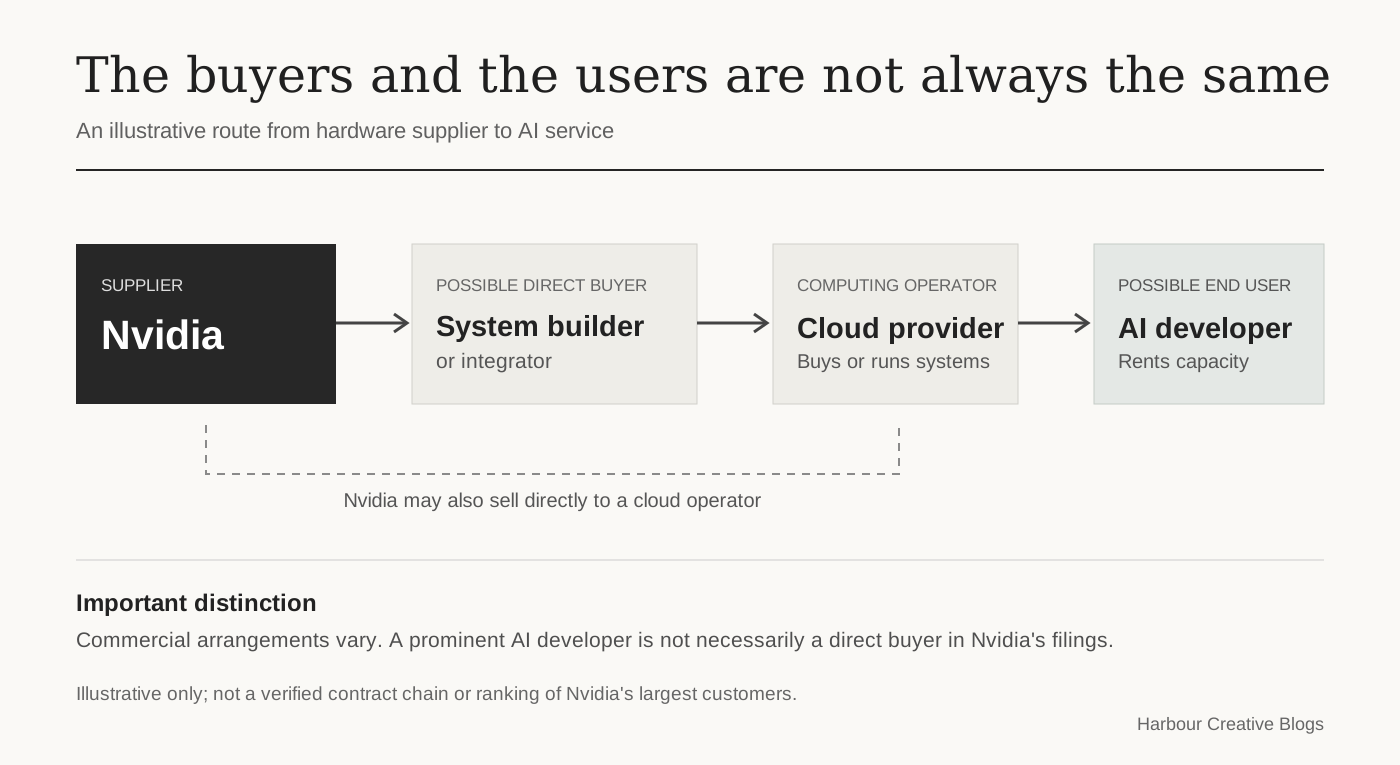
Illustrative routes only. A public technology partnership does not establish that the AI developer is a direct purchaser in Nvidia's accounts.
What the annual accounts disclose
For FY2026, Nvidia identified two unnamed direct customers representing 22 per cent and 14 per cent of its total revenue. It did not attach company names to those percentages.
The numbers establish concentration. They do not tell readers whether either customer is a hyperscale cloud operator, a systems company or another purchaser.
Naming a likely company would be conjecture rather than reporting. Even public claims about very large GPU deployments cannot establish the amount of revenue Nvidia recognises from a specific direct buyer in a given financial year.
The same caution applies to announced investments. A proposed multiyear infrastructure programme is not equivalent to a completed purchase, and an investment made by Nvidia in a customer does not itself demonstrate sales revenue from that customer.
The manufacturers and system builders
Nvidia's computing systems sit within a broad hardware industry. Companies such as Foxconn and Quanta have publicly participated in AI server manufacturing and related infrastructure. Dell, HPE and Supermicro supply servers or integrated systems to businesses and institutions.
Their roles can vary across projects. Some manufacture or assemble equipment; others design, configure, sell or support it. A single company may perform more than one function.
This matters for Nvidia because manufacturing capacity, component availability, assembly schedules and quality control can affect delivery even where demand from an end user is strong.
It also matters for the companies themselves. Large hardware orders may create revenue opportunities while exposing manufacturers to inventory requirements, production costs and customers whose capacity plans can change.
None of these general roles should be used to imply that a named manufacturer is one of Nvidia's anonymous 22 or 14 per cent customers. The public filing does not support that conclusion.
The cloud companies
Microsoft, Amazon, Google, Oracle and other cloud operators provide the infrastructure through which many organisations access AI computing.
They are important because they can aggregate demand from numerous customers. Instead of every developer buying a large fleet of chips, cloud providers invest in facilities and sell access to computing capacity.
Those providers also make decisions about architecture, energy supply, networking, software, financing and the lifespan of purchased equipment.
A leadership transition at Nvidia could affect future negotiations over products, capacity and technical roadmaps. But the degree of exposure differs by company and cannot be inferred simply from the number of public appearances between two chief executives.
The cloud operators are also potential competitors in part of the technology stack. Some invest in internally designed AI accelerators, both to control costs and to reduce reliance on externally supplied processors.
The AI model developers
OpenAI, xAI, Anthropic and other AI developers create demand for large amounts of computing power.
Their requirements can influence what infrastructure is built, but their purchasing routes vary. A developer may acquire some systems directly and obtain other computing capacity through a cloud partner.
This is one reason we should avoid publishing a supposed ranking of Nvidia's ten largest customers based on headlines about data-centre spending.
What we can examine is more useful: specific announced arrangements, their status, the products involved, financing structures and the technical reasons a developer might choose Nvidia or an alternative.
The role of executive relationships
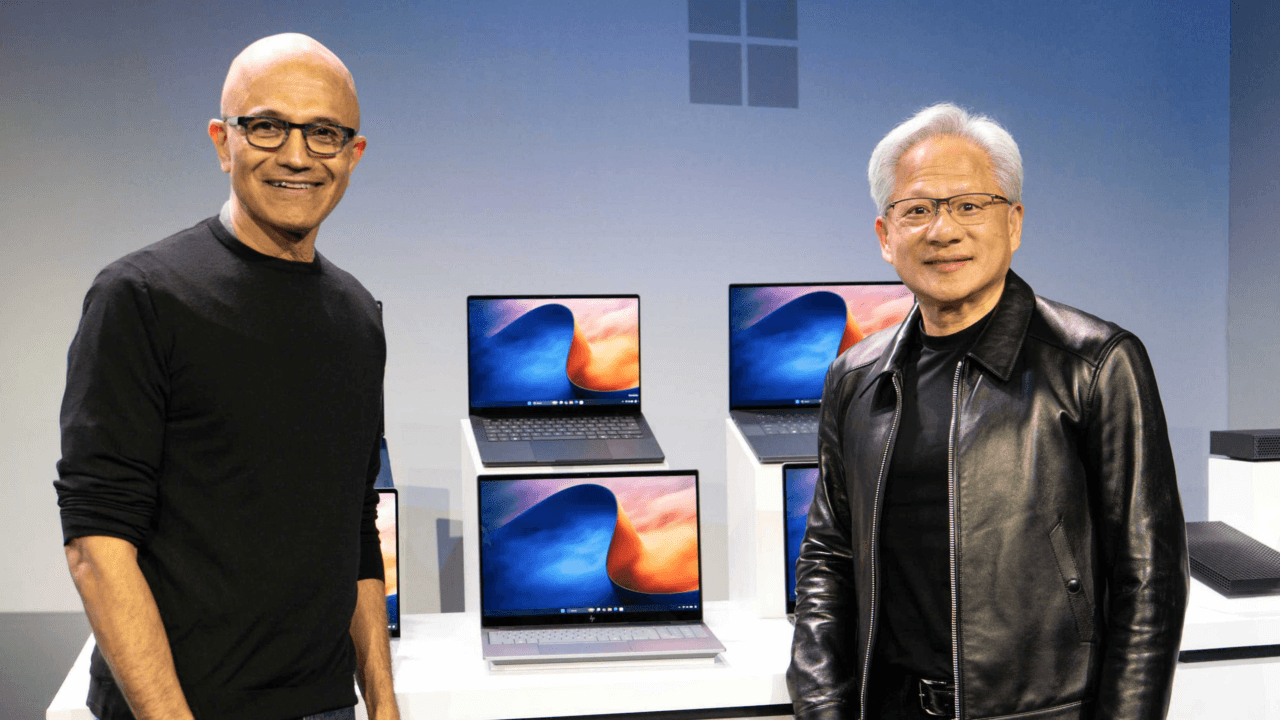
Jensen Huang spent decades building Nvidia's relationships across the technology industry. Major infrastructure partnerships commonly involve direct conversations among chief executives, especially when they concern long-term commitments or product development.
However, public photographs and friendly remarks do not establish the terms of an agreement. They also do not establish whether the partnership would weaken under different leadership.
A sound assessment needs two records: the documented relationship between the executives, and the documented relationship between the businesses.
After Huang's resignation on 12 November 2026, the central operational questions concern who will lead those negotiations, whether customer-facing engineering teams remain stable, and whether Nvidia continues to meet its product and delivery commitments.
What customers will be watching
For manufacturers, the immediate concerns are orders, component supply and production schedules.
For cloud operators, they include product delivery, performance, networking, pricing and the return on large investments.
For AI developers, the concern is access to enough reliable computing capacity at an affordable price, whether through Nvidia or competing technology.
These are related interests, but they are not interchangeable. Treating them as a single group obscures the different ways Nvidia earns money.
The next part
Nvidia's direct and indirect relationships reach far beyond AI data centres. The company remains a major presence in gaming PCs, professional workstations and vehicle computing, markets with their own purchasing cycles and competitive pressures.
The next article examines those businesses and the companies connected to them.
Reporting note: Named companies in this article are examples of documented industry participants, not a verified ranking of Nvidia's largest direct customers. Reported customer-concentration percentages are from Nvidia's FY2026 filing.
Next: Nvidia's Business Beyond AI.
About this article
This article provides analysis and interpretation of available information. Sources and supporting material, where applicable, are linked within the article.
Found an error? Contact the editorial desk. See our editorial standards and corrections policy.
From the Harbour Creative Blogs archive
Keep exploring this story
Related reporting, people and places from our published coverage. These are editorial connections, not a popularity ranking.
Subject
AI infrastructure
The data centres, chips, electricity and investment behind advanced artificial intelligence.
Company
Nvidia
The chipmaker at the centre of global AI investment: its revenue, products, leadership, customers and commercial relationships.