Part 1 · Analysis
How Nvidia Makes Its Money
Data centres account for almost 90 per cent of Nvidia's annual revenue. Its financial statements show how the AI boom has reshaped the business.
 Harbour Creative Team
7 min read
Harbour Creative Team7 min read
Part one of Nvidia: The Business and Its Partners.
Nvidia's transformation can be measured in a single financial figure. For the year ended 25 January 2026, the American chipmaker recorded US$215.94 billion in revenue, up from US$130.50 billion a year earlier. Most of that money came from a business which, a decade earlier, was far from the company's defining commercial activity: data centres.
The company once known principally for the graphics processors inside gaming computers is now an essential supplier of systems used to train and operate artificial intelligence. Its largest customers are investing in chips, networking technology and the equipment that joins thousands of processors into working computing clusters.
The result is a business of extraordinary scale, but with an unusually concentrated source of income. Nvidia's earnings depend increasingly on a relatively small number of large infrastructure purchasers and the investment plans of the companies behind them.
Five revenue markets, one dominant business
Nvidia discloses revenue across five end markets. The figures below are taken from its FY2026 annual report; they are not estimates of the value of contracts signed for delivery in later years.
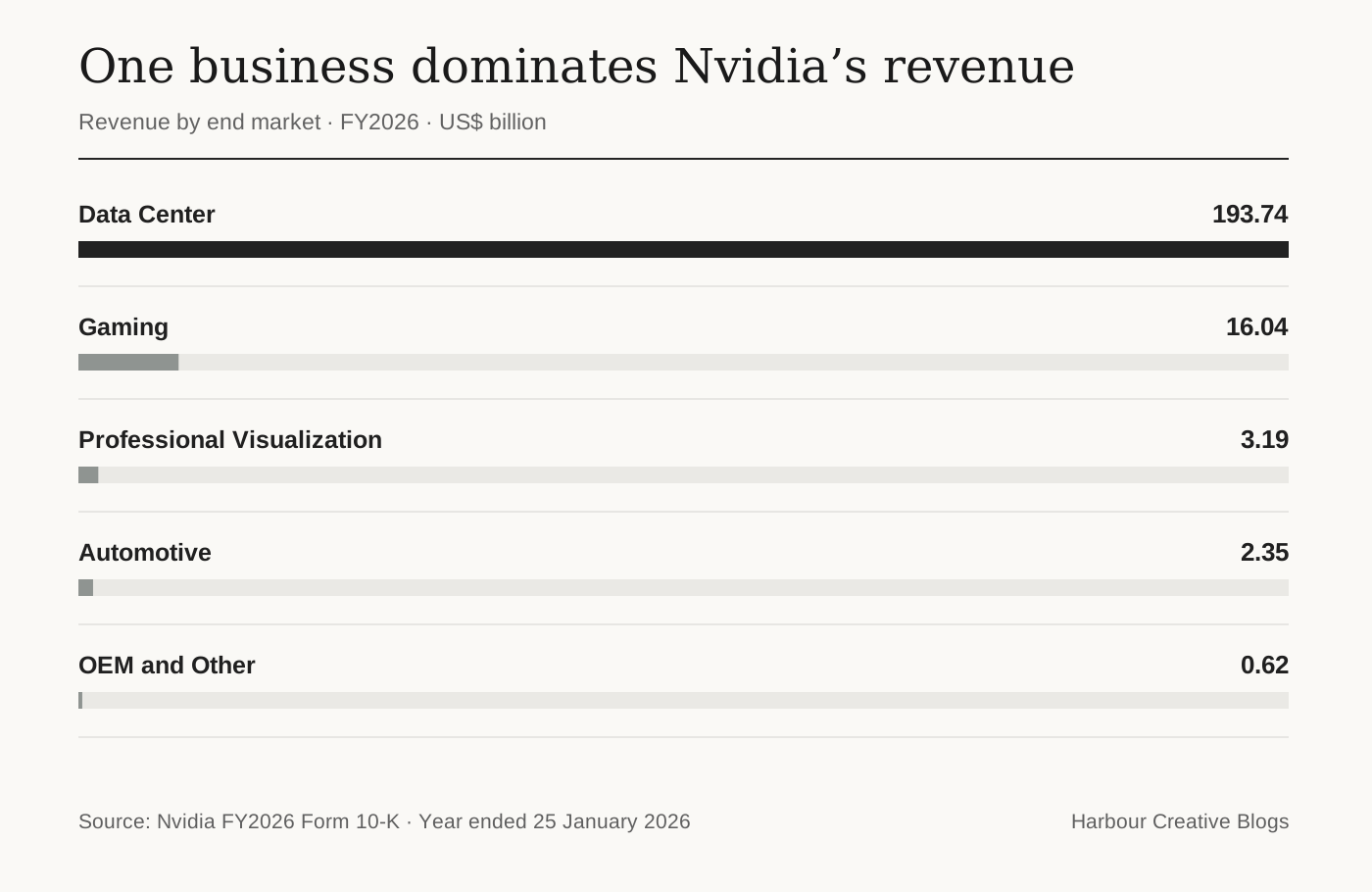
Source: Nvidia FY2026 Form 10-K, year ended 25 January 2026. Figures are in US dollars and rounded in the graphic.
| Business | FY2026 revenue | Share of total |
|---|---|---|
| Data Center | US$193.74 billion | 89.7% |
| Gaming | US$16.04 billion | 7.4% |
| Professional Visualization | US$3.19 billion | 1.5% |
| Automotive | US$2.35 billion | 1.1% |
| OEM and Other | US$619 million | 0.3% |
These five end markets should not be confused with Nvidia's two reportable operating segments, Compute & Networking and Graphics. The segments reflect how Nvidia reports its operating performance; the end markets describe where its products are used.
Data Center revenue grew from US$115.19 billion in FY2025 to US$193.74 billion in FY2026, an increase of about 68 per cent. Gaming also grew, but its smaller starting point means it contributed much less to the company's overall increase in revenue.
The comparison matters because it shows why developments in the AI infrastructure market now carry so much weight for shareholders, suppliers and Nvidia's management.
Nvidia sells more than individual chips
The usual description of Nvidia as a supplier of AI chips is accurate but incomplete.
Its Data Center revenue includes compute products and networking equipment. In FY2026, compute accounted for US$162.36 billion and networking for US$31.38 billion. A customer planning a large AI installation may need processors, systems connecting the processors and software that allows applications to run efficiently across the hardware.
Nvidia has worked to make these elements operate as a combined platform. Its CUDA software environment, networking technology and tightly integrated systems give developers and operators reasons to remain within the Nvidia ecosystem even when alternative chips become available.
That advantage has a commercial consequence. Moving a workload to another supplier can require changes to software, testing, infrastructure design and operating procedures. It is not necessarily comparable to replacing one brand of component with another.
The pace of AI investment also matters. Large cloud operators and technology companies can increase demand quickly when deploying new computing facilities. But construction schedules, power availability, financing and changing expectations for AI products can alter those plans.
Nvidia's dependence on major purchasers
One of the most revealing disclosures in Nvidia's annual report concerns customers whose names it does not publish.
In FY2026, one direct customer represented 22 per cent of Nvidia's total revenue. A second accounted for 14 per cent. Combined, the two represented more than one-third of the company's revenue.
At the reported annual total, those shares are equivalent to approximately US$47.5 billion and US$30.2 billion respectively. Those are calculations from reported percentages, not separate company-disclosed sales figures.
The names of those customers were not provided in the filing. It would be misleading to attach the percentages to Microsoft, Amazon, Foxconn or any other company without evidence.
This distinction is essential to understanding Nvidia's business. A direct customer might be a company that purchases products to assemble computing systems or supply another organisation. An AI developer might be financially important to Nvidia while obtaining computing capacity from a cloud provider rather than buying the physical systems itself.
Consequently, the companies most visible in Nvidia's announcements are not necessarily the same as its largest direct purchasers.
The other businesses still matter
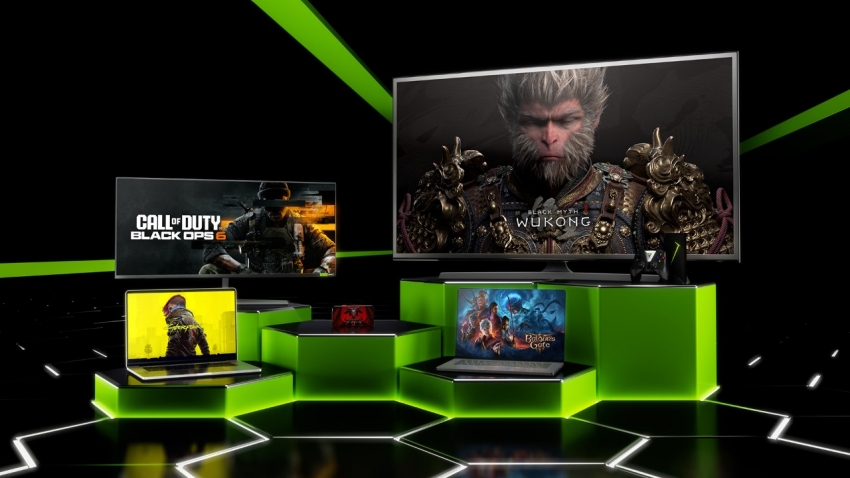
GeForce remains central to Nvidia's gaming business, even as Data Center accounts for most revenue.
Nvidia's Gaming market includes GeForce products used in desktop computers, gaming laptops and other gaming applications. Computer manufacturers, graphics card makers, retailers and consumers all participate in that market. It is commercially different from selling equipment for a cloud computing installation, with different product cycles and purchasing decisions.
Professional Visualization serves users who need specialised graphics and computing performance for design, engineering, research and creative production. It has relationships with workstation manufacturers and professional software ecosystems. Not every software company whose products run on Nvidia hardware is a direct customer.
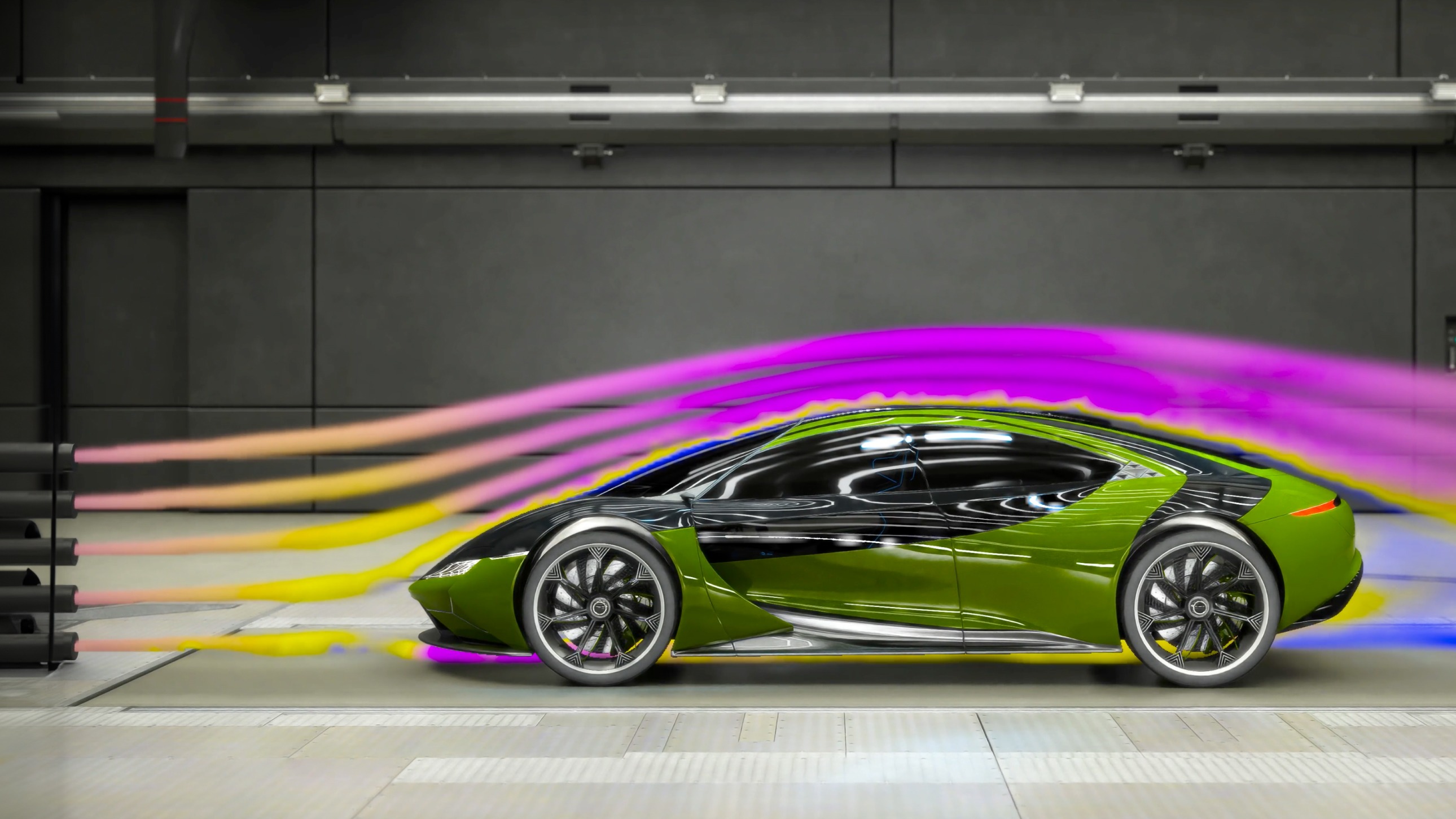
Nvidia's automotive business operates on the longer design and production cycles of the car industry.
Automotive covers technology used in vehicle computing and autonomous-driving development. The time between announcing a vehicle technology partnership and achieving production revenue can be substantial, because vehicles have lengthy design, testing and regulatory cycles.
OEM and Other is the smallest category. Its name should not be taken to mean that every major original equipment manufacturer buying Nvidia technology belongs in it; many such purchases support other end markets.
These businesses collectively account for a small share of current revenue, but they provide context for Nvidia's development and show that its commercial ties extend far beyond the current AI boom.
What a change of chief executive means
On 12 November 2026, Nvidia announced that co-founder Jensen Huang had resigned as president, chief executive and a board director. Chief financial officer Colette Kress was appointed interim chief executive.
For a business with long-running engineering projects and contracts, the departure of a chief executive does not itself cancel orders or stop deliveries. Suppliers still have production schedules. Customers still have installations to complete. Engineers continue working on product development.
The longer-term issues concern decisions that require senior leadership: capital allocation, product priorities, negotiations with the largest customers and the maintenance of relationships that Huang developed over more than three decades.
A personal relationship between executives can help a commercial partnership, but it does not establish that a contract depends on either individual remaining in office. Each relationship requires separate examination.
The leadership change also arrives while Nvidia faces competition from rival processor suppliers and from customers developing their own AI chips. The question is not whether those alternatives exist. It is where they are commercially viable, how quickly they can be deployed and what work is needed to replace existing Nvidia systems.
Why this matters for Australian businesses
Most Australian organisations do not purchase Nvidia's largest AI systems directly. They encounter the technology through cloud platforms, software products, service providers and computer equipment.
If infrastructure costs or cloud pricing change, Australian businesses may feel the effects indirectly. If competing chips lower the cost of running AI applications, the benefit may also flow through providers rather than appearing as a direct hardware purchase.
The distinction between a manufacturer, a cloud operator and a software customer therefore matters beyond the US technology sector.
Following the money
Nvidia's revenue figures show the scale of its success, but not the full chain of businesses behind every dollar. The next question is who purchases the systems, who assembles them, who uses them and which relationships are commercially material.
That is where this series turns next.
Reporting note: FY2026 refers to Nvidia's financial year ended 25 January 2026, not the calendar year. Figures and percentages are rounded. Customer identities are not inferred from unnamed disclosures.
Next: Nvidia's Major Customers and Supply Chain.
About this article
This article provides analysis and interpretation of available information. Sources and supporting material, where applicable, are linked within the article.
Found an error? Contact the editorial desk. See our editorial standards and corrections policy.
From the Harbour Creative Blogs archive
Keep exploring this story
Related reporting, people and places from our published coverage. These are editorial connections, not a popularity ranking.
Company
Nvidia
The chipmaker at the centre of global AI investment: its revenue, products, leadership, customers and commercial relationships.
Subject
AI infrastructure
The data centres, chips, electricity and investment behind advanced artificial intelligence.