Part 6 · Analysis
The Jensen Huang Crisis: Can Nvidia Outgrow Its Founder?
As Nvidia's board weighs its founder's future, reported relationships have raised difficult questions about governance, national security and who could lead the AI chipmaker next.
 Harbour Creative Team
8 min read
Harbour Creative Team8 min read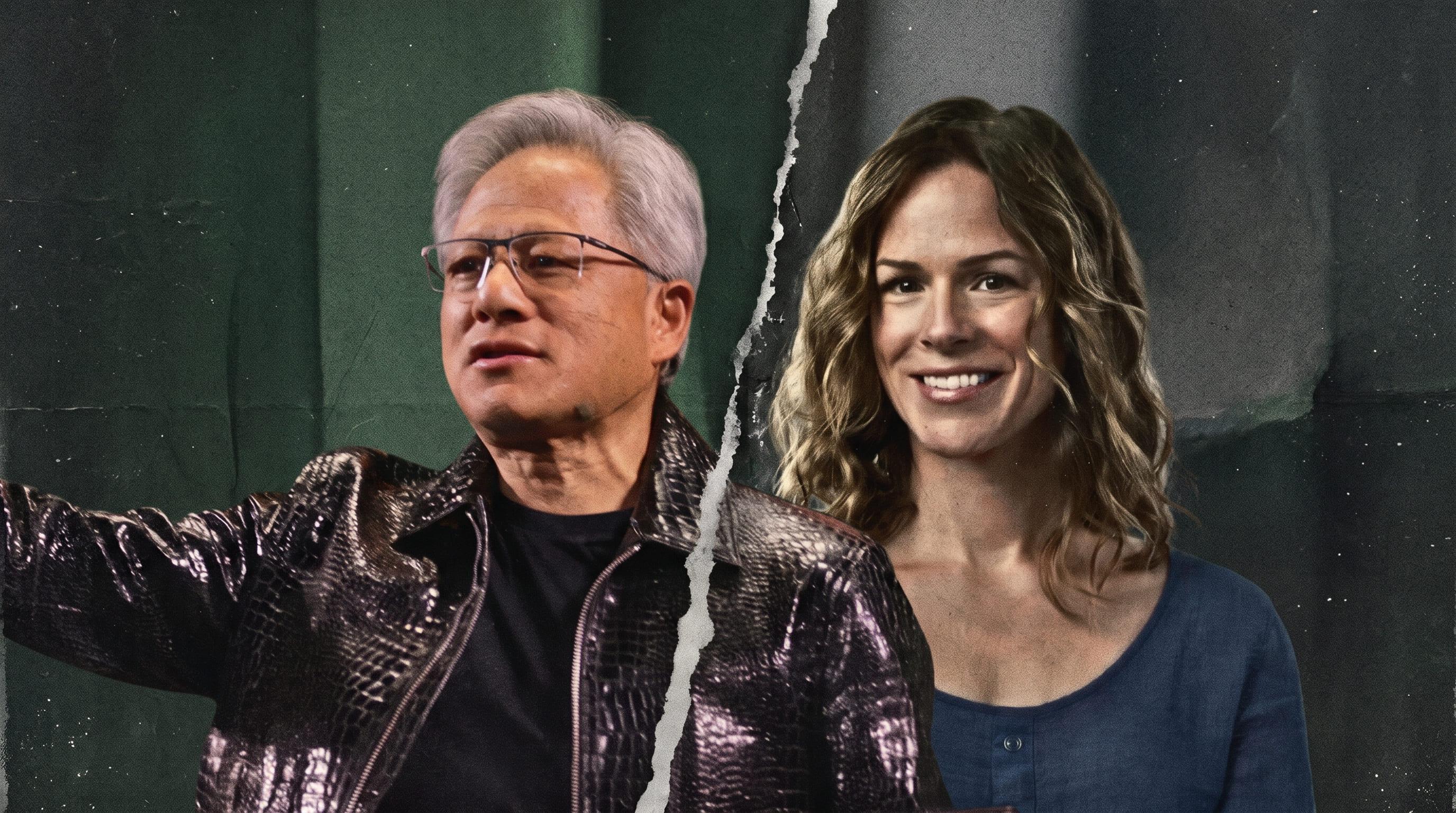
The Battle for AI Power — Part Six
Reporting reviewed through 12 November 2026.
For more than three decades, Jensen Huang and Nvidia have been difficult to separate. The company he co-founded in 1993 grew from a graphics-chip specialist into the supplier of processors and software that much of the modern artificial intelligence industry depends upon. Huang became its most recognisable salesman, chief strategist and public face. Then, within days in November 2026, a dispute about his conduct became an argument over who should lead one of the world's most valuable businesses.
The issue now confronting Nvidia is larger than a single executive's private life. The questions its directors must answer concern possible conflicts of interest, the handling of sensitive information, the company's relationship with Washington, and whether an institution central to the AI economy has made itself too reliant on one individual.
The first allegation and the question of national security
In late October, reporting connected Huang to Alice Huang, a business executive formerly associated with Singapore-based Megaspeed. They are not related. U.S. intelligence officials were reported to have suspected that Alice Huang had links to Chinese intelligence. Those claims have not been established in a public court proceeding and were not independently verified by Reuters. China's foreign ministry rejected the spying allegation.
Megaspeed had separately faced scrutiny over suspected efforts to help Chinese customers gain access to restricted advanced computing chips. That context made the allegations unusually sensitive for Nvidia. Its products sit at the intersection of commercial demand and American export-control policy; access to its most capable processors is itself a geopolitical dispute.
On 8 November, Huang acknowledged in a message to employees that he had been unfaithful to his wife. Nvidia's board announced an independent investigation on the same day, describing the inquiry as a response to reporting that its CEO had been targeted by a foreign-intelligence effort. Its statement said that the directors had no reason at that point to believe either national security or Nvidia secrets had been compromised. It also expressly affirmed their confidence in Huang and his leadership team.
Those distinctions matter. An intelligence-related concern is not proof of espionage, and a personal relationship is not, by itself, evidence that restricted technology or confidential information changed hands. At the same time, an independent board cannot simply ignore allegations that may create vulnerabilities in the leadership of a strategically important company.
The independent directors subsequently retained the law firm Wachtell, Lipton, Rosen & Katz to assist their review. The investigation's findings had not been publicly announced as of this draft's reporting cutoff.
A second reported relationship changes the boardroom discussion
On 11 November, The New York Times reported an alleged second relationship, this time between Huang and Kimberly Powell, Nvidia's vice president of healthcare, who reportedly reported to him. Reuters repeated the central claims while noting that it could not independently verify the report. Nvidia and Powell had not publicly confirmed the allegation in the reporting reviewed for this article.
A relationship involving a senior executive and someone within that executive's reporting structure raises a distinct set of workplace concerns. Questions can include whether the relationship was disclosed, whether employment or promotion decisions were affected, whether company policy was followed, and whether other employees could raise objections without fear. None of those questions should be mistaken for a finding that improper decisions occurred. They are matters an effective investigation should establish through evidence.
The alleged second relationship arrived while the board was already investigating the intelligence-related controversy. Within hours, The Wall Street Journal reported that directors were preparing to remove Huang. Reuters subsequently reported, citing a person familiar with the matter, that the board was meeting to decide whether to oust him. CBS News separately reported that the board was preparing to act.
These accounts describe deliberations and reported intentions. They do not constitute an official announcement that Huang has been dismissed. At the reporting cutoff for this draft, Nvidia's 8 November statement remained the clearest formal description of the board's position available in the sources reviewed.
The market's response was immediate. Nvidia shares fell more than 8% in extended trading following reports about the possible leadership change. After-hours prices can shift quickly and do not necessarily predict the following session's close, but the reaction made investors' unease visible: a corporate-governance crisis at Nvidia is also an event for the broader AI sector.
Why Nvidia's chief executive matters so much
A modern technology company is not solely its chief executive. Nvidia has a deep engineering organisation, long-standing customers, product teams and a substantial software ecosystem. Its competitive position rests on more than one person. The CUDA programming platform, its networking technology, and the design and manufacture of successive GPU generations involve many thousands of decisions made far from any public stage.
Yet Huang has shaped how the company connects these parts. He has spent years arguing that computing would move towards accelerated processing, cultivating developers as carefully as hardware buyers, and positioning Nvidia's platforms as the foundation for increasingly complex AI systems. His annual keynotes have often functioned as industry events: cloud firms, start-ups and investors listen for clues about available computing power and the next generation of products.
The distinction between operational continuity and strategic continuity is therefore important. Chip orders do not necessarily disappear when a CEO leaves. Designs already under development do not automatically stall. But the person who negotiates relationships with hyperscalers, articulates the product roadmap, handles regulators and attracts technical talent can still be consequential.
Whether an immediate leadership change would be damaging depends on details the public does not yet know: the board's succession arrangements, the authority held by senior executives, how the largest customers are managed, and whether a potential successor could preserve trust while reassuring regulators and employees.
The harder problem: governing the founder
Founder-led technology companies often benefit from unusually consistent leadership. Their founders can take long-term bets that a rotating management team might avoid. Nvidia's transformation across multiple computing eras illustrates the value of that continuity.
But longevity also changes the governance challenge. When an executive becomes central to a company's identity, directors may find it harder to distinguish the institution's interests from the leader's interests. A founder's record of achievement does not remove the board's obligation to examine conflicts, disclosures and risk. Neither does an allegation alone justify assuming misconduct beyond what has been established.
This is why the board's choices are not limited to an unthinking defence or an immediate dismissal. Directors must weigh evidence, legal obligations, the credibility of the review, potential safeguards, continuity of leadership and the trust of employees and investors. The relevant test is whether the board can make—and demonstrate—an independent decision.
One reported investor lawsuit has also placed disclosure practices under scrutiny. Litigation allegations remain allegations unless proved or resolved; they should not be presented as findings that shareholders were deceived. But the existence of such challenges raises the stakes for how consistently Nvidia communicates with the market.
A geopolitical company cannot treat trust as a private matter
Nvidia's position makes the episode unusual. Its chips are commercial products, but they are also treated by governments as strategically sensitive technology. Export restrictions, Chinese demand, American industrial policy and the enormous capital commitments of AI data centres intersect in its business.
The alleged foreign-intelligence dimension therefore invites scrutiny from officials whose concerns go beyond ordinary corporate governance. Washington wants confidence that restrictions on advanced semiconductor exports are respected. Investors want confidence that leadership decisions will not disrupt supply or create undisclosed risk. Nvidia's customers want confidence that the company can deliver successive generations of hardware on schedule.
None of those interests requires assuming that trade secrets were compromised. Nvidia has said it has no reason to believe that they were. The point is that a credible investigation must be able to answer the question, rather than rely only on the company's reputation or its executive's accomplishments.
What happens next
There are several potential outcomes. The board could retain Huang, with or without additional safeguards; it could arrange a managed transition; or it could move quickly towards new leadership. Reporting that directors have discussed removing him does not establish which decision they will ultimately make.
The most important things to watch are an official board announcement, any securities filing relating to the chief executive, the scope and outcome of the independent investigation, reactions from major customers, and Nvidia's forthcoming quarterly earnings communication. The board also needs to explain how it intends to govern the company after this episode, regardless of who occupies the top office.
For the AI industry, the central question is whether Nvidia's extraordinary position is built on a durable institution or on a founder whose presence the market has come to regard as indispensable. That question cannot be answered by a single day's share-price movement. It will be answered by how the company's people, products, relationships and governance hold together under pressure.
Huang helped build the infrastructure on which much of the AI race now runs. The next test may be whether that infrastructure—and the business behind it—can stand independently of the man who made it famous.
Sources and further reading
- Nvidia board statement, 8 November 2026 — primary source on scope of investigation and board's stated position.
- Reuters explainer on possible legal exposure, 11 November — allegations, Reuters' explicit verification limits, litigation.
- Reuters reporting on board deliberations, 11 November — board meeting reporting and market response.
- TechCrunch on second reported relationship, 11 November — credits original New York Times reporting.
- Associated Press on the inquiry and unanswered questions — independent synthesis.
- Washington Post on succession questions, 11 November — board report and strategic importance.
About this article
This article provides analysis and interpretation of available information. Sources and supporting material, where applicable, are linked within the article.
Found an error? Contact the editorial desk. See our editorial standards and corrections policy.
From the Harbour Creative Blogs archive
Keep exploring this story
Related reporting, people and places from our published coverage. These are editorial connections, not a popularity ranking.
Company
Nvidia
The chipmaker at the centre of global AI investment: its revenue, products, leadership, customers and commercial relationships.
Person
Jensen Huang
Nvidia's co-founder and former chief executive, whose leadership and departure feature in our technology reporting.
Subject
AI infrastructure
The data centres, chips, electricity and investment behind advanced artificial intelligence.