The Extraordinary Life of Alice Huang: From China to Nvidia and Back to Beijing
From a little-documented early career to Shanghai finance, Singapore's AI chip trade and an international controversy, the story of Alice Huang is a journey through the changing technology economy.
 Harbour Creative Team
12 min read
Harbour Creative Team12 min read
An account of a life reconstructed from public reporting, business records and unanswered questions. Reporting reviewed through 12 November 2026.
On 12 November 2026, a report placed Alice Huang in Beijing. It was a deceptively simple update to a story that had spread across business news, Washington and the technology industry. Bloomberg, citing people familiar with the matter, reported that the Chinese businesswoman was living in the capital with the knowledge of security officials. It remained unclear when or why she had travelled there.
By then, her name had become inseparable from Nvidia, the American chipmaker at the centre of the artificial-intelligence boom, and from extraordinary allegations concerning its chief executive, Jensen Huang. Yet the most interesting question about Alice Huang is not simply what brought her into the headlines. It is how someone whose early life remains so little documented came to occupy a position in a business supplying some of the world's most sought-after computing technology.
The journey runs through China's media and investment industries, Shanghai's financial district, a Singapore company originally connected to video games, and the international struggle over access to advanced AI chips. Some parts are supported by filings, photographs and company statements. Others survive only in online biographies or accounts that reporters have been unable to verify.
That difference is central to telling her story fairly.

Chapter One: The early years that remain out of view
Accounts of prominent business figures often begin with a hometown, a school or a formative childhood event. For Alice Huang, even those basic details are uncertain in the public record.
She is also known by the Chinese name Huang Le. Chinese business publication Caixin has reportedly described her as being about 42 years old in 2026. But a precise date of birth, confirmed educational history and dependable account of her upbringing have not been established in the principal international reporting reviewed for this article.
Some online accounts have suggested a rural background in Hunan province. Without sufficiently reliable confirmation, it would be misleading to present a childhood there as established fact, or to invent the family circumstances that might explain her ambitions.
There is more to work with when the story reaches her professional life, although even there the earliest claims require care. A profile on Chinese private-fund database Simuwang, discussed by Reuters and other news organisations, describes a period in television journalism before a move into finance. It lists Hunan TV and the national broadcaster CCTV among her reported employers. The Guardian and EL PAÍS noted that reporters had not been able to independently confirm the full résumé.
If accurate, the transition is revealing. Television reporting, private banking and technology investment are very different professions, but each involves relationships, access to decision-makers and an understanding of institutions. Whether that overlap shaped Huang's later career cannot be established. It is a possibility, not a documented motive.

Her reported television career appears in an online financial-industry profile; independent verification of the early résumé remains limited.
Chapter Two: A move into the world of money
The first comparatively firm trail appears in the Chinese investment industry.
According to Reuters' review of more than 30 corporate and financial records, Shanghai Hexi Investment Management identified Huang in official social-media posts from 2016 and 2017 as a deputy general manager, executive director and member of its investment decision committee. Company materials also described previous roles at HSBC's private bank in Hong Kong and at CITIC Securities.
Those descriptions are useful evidence of how she was presented professionally, but the banks did not independently confirm her employment when approached by reporters. The Hexi positions are more directly supported by the investment firm's own records.
An old Hexi business card examined by Reuters gave Huang another set of titles: partner and general manager. Its address was in Lujiazui, Shanghai's financial district, where glass towers overlooking the Huangpu River house banks, investment firms and some of the country's most influential corporate offices.
This was a different world from the television career mentioned in her online profile. Finance offered access to transactions, founders, fast-growing companies and the flow of capital behind new technologies. By the middle of the 2010s, China's internet industry was attracting investment on a remarkable scale.
What is not known is how Huang obtained each job, what wealth she accumulated or how much authority she personally exercised over particular investments. Those details cannot be reconstructed from a title alone.

Shanghai's Lujiazui district was the location on a business card reviewed by Reuters identifying Huang as a Hexi partner and general manager.
Chapter Three: The connection to video games
One of the more consequential threads in Huang's business history leads not to artificial intelligence, but to gaming.
The Singapore business that later became Megaspeed International was originally incorporated in 2015 as 7Road International, linked to the Chinese video-game enterprise 7Road Holdings. This distinction matters: Huang did not create the original Singapore legal entity from nothing in 2023. The business that became Megaspeed already had a corporate history.
According to reporting by Axios and EL PAÍS, Shanghai Hexi had investment connections to 7Road. Axios also cited documents indicating that Huang sold a cloud business to 7Road in 2019. Those accounts offer a possible commercial bridge between her investment work and the company she would later control.
Gaming and AI computing may seem like separate industries, but their infrastructure has overlapping roots. Nvidia became powerful in graphics processing long before its products came to dominate much of the modern AI industry. Powerful GPUs, initially associated with gaming and visual computing, could be adapted to the enormous parallel calculations required by machine-learning systems.
A business familiar with gaming technology could therefore find itself unusually well positioned as demand shifted toward AI processors. That broader industry transition is established. How precisely Huang assessed the opportunity, and which decisions were hers rather than those of other executives, is less clear.
Still, her subsequent involvement in the transformed Singapore company is documented.
Chapter Four: Singapore, Megaspeed and a changing market
By March 2023, the corporate story had reached a turning point. The Singapore company previously called 7Road International took the name Megaspeed, and Huang became its controlling shareholder, according to corporate records reviewed by Washington-based research organisation C4ADS and cited by Reuters.
Bloomberg reported that ownership of the former 7Road subsidiary moved through a British Virgin Islands company called Huang Le Ltd. In November 2023, Huang Le Ltd sold Megaspeed to a Singapore company, after which Megaspeed received official Nvidia Cloud Partner status. Other reporting identifies the purchaser as Swiftdata and says Huang had resigned from its board by November.
These transactions make it unsafe to describe Megaspeed simply as a business she founded and continued to own. She played a central role in its 2023 transformation, but ownership, directorship and day-to-day influence are different things. The public record does not resolve exactly how long she continued to exercise influence after the formal changes.
A separate chapter unfolded in Indonesia. C4ADS records cited by Reuters placed Huang as a director and managing director of Megaspeed's Indonesian subsidiary between March and November 2023.
In the new AI economy, cloud companies can buy advanced chips, install them in data centres and rent access to the computing power. Customers need not own the hardware themselves. This model became especially attractive as demand for AI training and inference surged.
Megaspeed was entering that world at a moment when access to powerful chips had become both commercially valuable and geopolitically contentious.

Megaspeed's corporate transformation took place in 2023, after the business had previously operated as 7Road International.
Chapter Five: A business built around scarce technology
For most of the 2010s, graphics processors were principally associated in the public imagination with computer games, visual effects and specialist scientific work. By 2023, the explosion of generative AI had transformed demand for Nvidia's highest-performance products.
The companies able to secure and deploy large numbers of processors occupied an increasingly powerful position. They could lease computing capacity to firms developing AI models, expanding digital services or running demanding workloads.
Megaspeed became a significant participant in that market in Southeast Asia. Bloomberg's November 2026 reporting put the value of its Nvidia-related imports at more than US$4.6 billion and reported that its computing facilities rented capacity to customers including Alibaba.
The import figure describes business activity associated with Megaspeed, not Huang's personal wealth, and it is not evidence by itself of an export-control breach. Her formal ownership and executive positions had changed after 2023.
That distinction matters because the company operated in a market where commercial success could be viewed very differently by competing governments. Washington restricted exports of certain advanced AI processors to China. Chinese businesses still wanted access to immense computing power. Cloud infrastructure in other jurisdictions sat at the intersection of those demands.
In October 2025, The New York Times reported that US authorities were examining whether Megaspeed had helped Chinese customers gain access to technology restricted under American export rules. Singaporean authorities also investigated suspected violations of domestic law.
On 12 November 2026, Megaspeed said it took American export-control compliance seriously, had cooperated with US inspections and had engaged a US law firm to review its GPU inventory and practices. Reuters reported the company's response.
An investigation into the company is not a finding that it broke the law, nor is it proof that Huang personally directed any improper transaction.
Chapter Six: The Nvidia connection becomes public
The relationship between the Megaspeed business network and Nvidia brought Huang into increasingly prominent company.
Reuters documented that Huang and Nvidia CEO Jensen Huang were present at a party hosted by Taiwanese server manufacturer Gigabyte during the Computex trade show in 2024. A photograph shared on LinkedIn showed them seated next to each other.
The image is one verified point of contact. It cannot establish when they first met, how their relationship developed or what they discussed. Reports have raised the possibility of earlier professional connections, but the precise chronology is disputed or incomplete.
For people outside the technology industry, it is easy to underestimate Nvidia's importance. The company supplies not only chips but also the software and networking systems on which much of the world's AI infrastructure depends. Jensen Huang, its co-founder, has led it since 1993.
By 2026, an alleged relationship involving its chief executive was therefore not merely a story about a prominent businessman's private life. It intersected with commercially sensitive technology, US-China relations and an investigation into a major Nvidia customer.
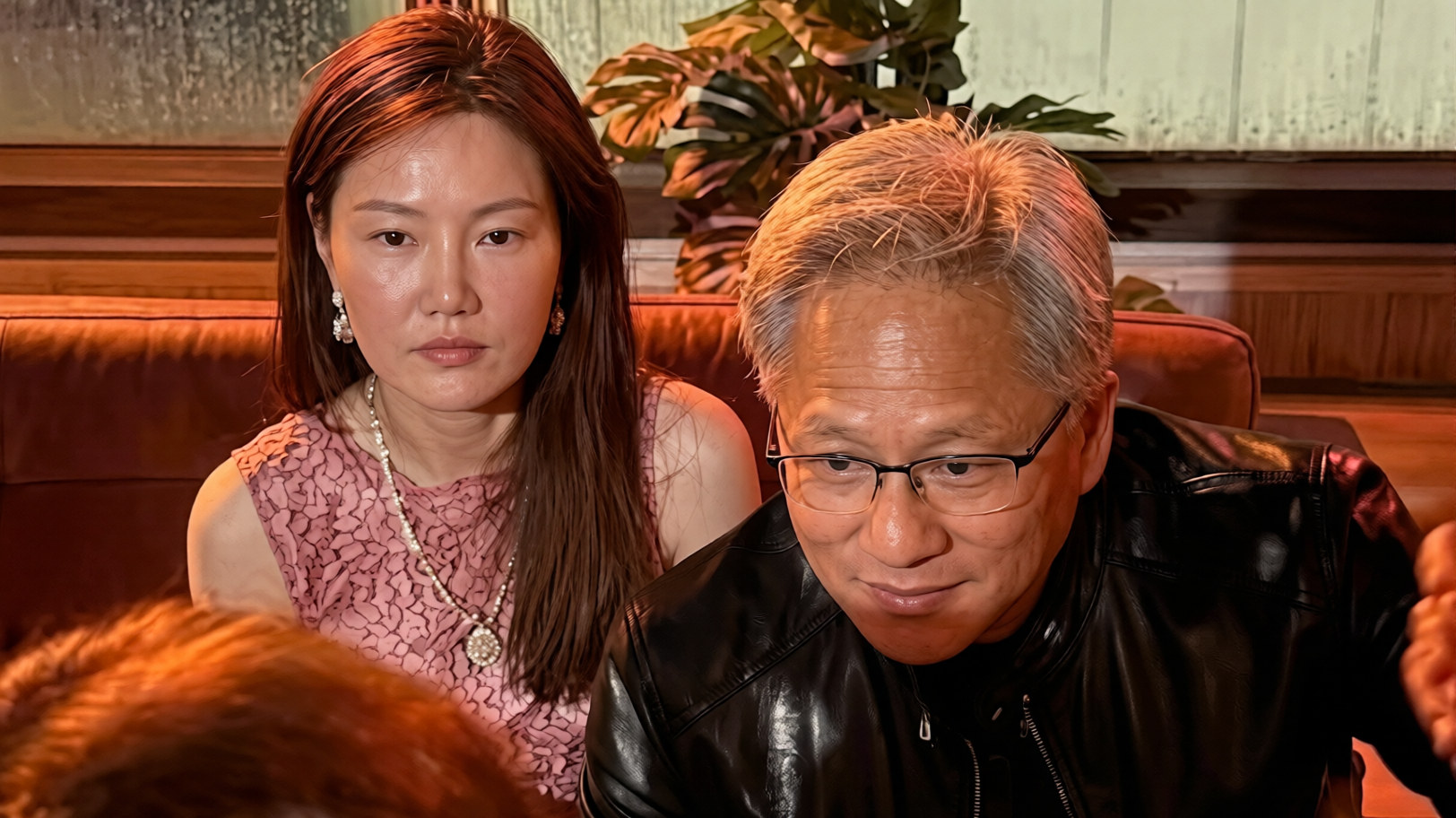
Reuters reported that the two were photographed together at a 2024 industry event. A photograph alone does not establish the nature or duration of a relationship.
Chapter Seven: An allegation heard around the world
In November 2026, reporting about Alice Huang and Jensen Huang expanded into allegations of espionage.
The New York Times reported that US intelligence officials believed Alice Huang had been recruited by Chinese intelligence to target the Nvidia chief executive. Reuters said it could not independently verify those allegations. Beijing rejected them. The precise information, if any, that she might have obtained or passed on has not been publicly established.
On 8 November, Jensen Huang acknowledged that he had been unfaithful to his wife. Nvidia's independent directors opened an investigation into reporting of a possible foreign-intelligence effort targeting him. The company said at the time it had no reason to believe that Nvidia trade secrets or national-security information had been compromised.
A confession of infidelity is not a confession of espionage. Nor should the existence of a personal relationship be treated as proof that information was stolen or export rules were violated.
Alice Huang herself has not offered a detailed public account in the reporting reviewed for this feature, and journalists have reported being unable to reach her. That absence has created space for speculation. It does not justify filling the gaps with imagined conversations, motivations or clandestine scenes.
Her story involves a real business career that can be investigated on its own terms, regardless of the unresolved national-security claims.
Chapter Eight: Back to Beijing
Then came the report of 12 November.
Bloomberg said Huang was living in Beijing, citing people familiar with the matter. One source said security officials knew her whereabouts. Reuters relayed the report but could not independently verify it.
Neither the reason for her reported return nor the timing of her journey was established. There was no reliable basis to say she had fled, been recalled by officials, secured protection or retired to a peaceful life. Her presence in Beijing, if confirmed, would not decide the truth of the allegations.

Bloomberg reported on 12 November that Huang was in Beijing; her reasons for travelling there remain unknown.
The contrast is striking nevertheless. Years earlier, her public professional record placed her among investment firms in Shanghai. Later, business records connected her to a Singapore company operating in one of the fastest-growing and most politically sensitive sectors of technology. By November 2026, she had become an internationally recognised name for reasons she had not publicly explained.
An extraordinary journey, still without a final chapter
Biographies can make a life look inevitable: the childhood that explains an ambition, the first job that predicts the next, the chance meeting that changes everything. Alice Huang's record resists that kind of neat storytelling.
There is no reliable basis for reconstructing her private childhood or placing words in her mouth. The precise transition from media to finance is incompletely documented. The difference between controlling Megaspeed in 2023 and directing it after ownership changes deserves close examination. So does the difference between a national-security accusation and a proven act.
What can be said is substantial enough. Her documented business trajectory passed through Chinese investment management, the restructuring of a Singapore technology company and the rapidly growing market for AI computing. That path put her near one of the industry's most influential executives, before allegations transformed her into a figure of worldwide scrutiny.
Her reported return to Beijing offers a geographical ending, not a settled biographical one. The investigations, questions about corporate control and allegations concerning intelligence activity remain unresolved.
From the offices of Shanghai finance to Singapore's AI computing industry, her career crossed several of the defining economic changes of the past decade. Where her story goes next is still unknown.
Reporting and sources
- Reuters — Alice Huang, Chinese businesswoman tied to Nvidia CEO, went from finance to chips (10 November 2026)
- Bloomberg via The Straits Times — Alice Huang reportedly living in Beijing (12 November 2026)
- EL PAÍS — Unverified early career claims and documented Megaspeed history (9 November 2026)
- Axios — Alice Huang and the corporate history of Megaspeed (9 November 2026)
- The Guardian — What is known about Alice Huang (9 November 2026)
- Reuters — Megaspeed says it cooperated with US inspections (12 November 2026)
Editorial note: This profile distinguishes documented corporate records, reported claims and information that has not been independently verified. The allegations of espionage are not established findings.
About this article
This article provides analysis and interpretation of available information. Sources and supporting material, where applicable, are linked within the article.
Found an error? Contact the editorial desk. See our editorial standards and corrections policy.
From the Harbour Creative Blogs archive
Keep exploring this story
Related reporting, people and places from our published coverage. These are editorial connections, not a popularity ranking.
Person
Alice Huang
A former technology executive discussed in reporting on the scrutiny of Nvidia's leadership and international business ties.
Subject
AI infrastructure
The data centres, chips, electricity and investment behind advanced artificial intelligence.
Company
Nvidia
The chipmaker at the centre of global AI investment: its revenue, products, leadership, customers and commercial relationships.