AI Is Watching Australian Workers. Researchers Want Stronger Laws
A new UTS report warns that AI-powered workplace monitoring is outpacing Australian protections. Its proposed reforms could change how employers track staff.
 Harbour Creative Team
5 min read
Harbour Creative Team5 min read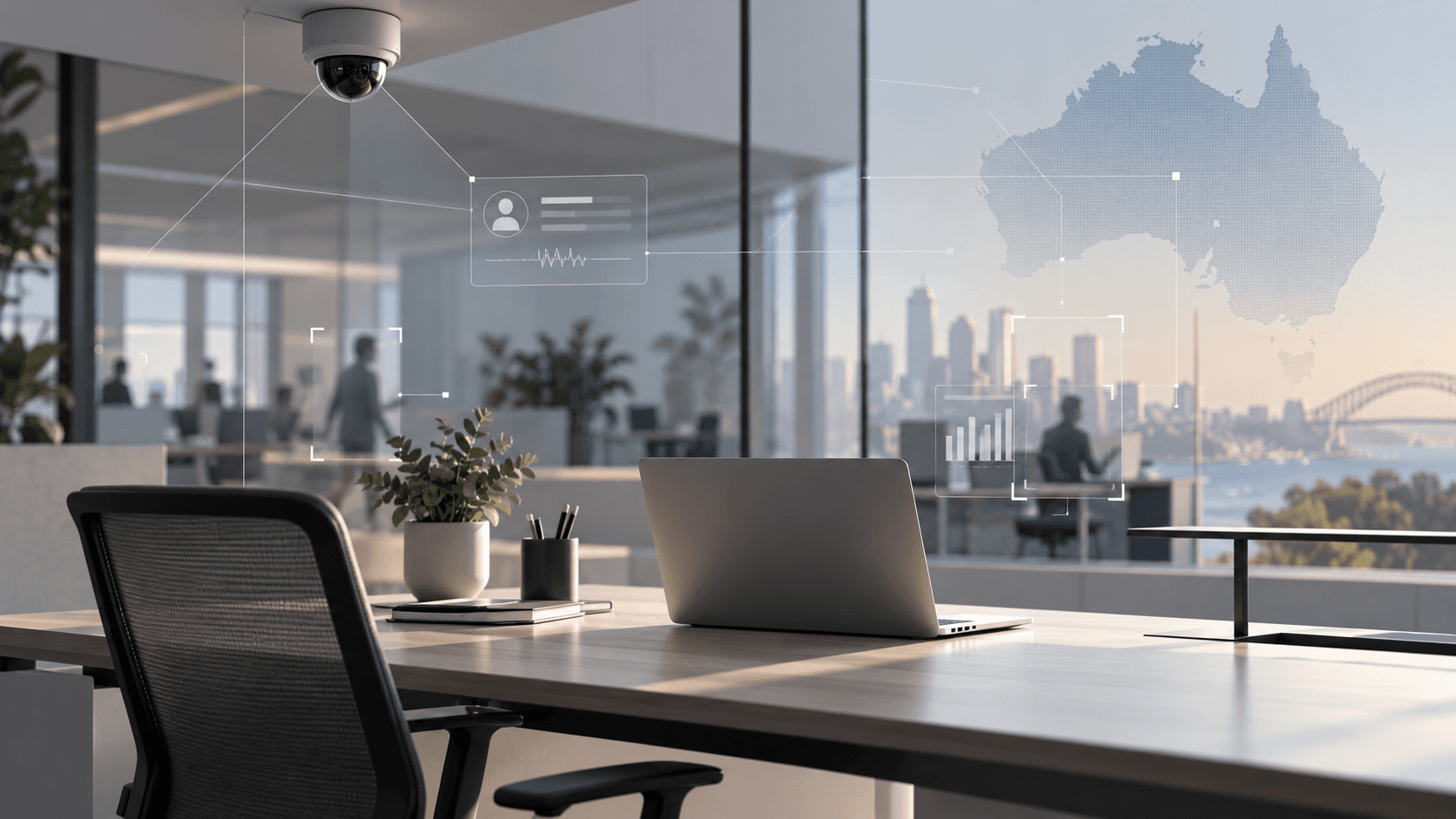
Your workplace might know more about your working day than you realise. Cameras, card-access systems, workplace software and productivity dashboards can all leave records of what employees do. Artificial intelligence makes those records easier to combine, interpret and turn into judgements about performance.
Now Australian researchers are asking whether the rules governing that monitoring have kept pace.
On 20 October, the University of Technology Sydney's Human Technology Institute (HTI) released Drawing the Line, a report calling for national reform to address harmful technology-enabled worker surveillance. The institute wants the Fair Work Act amended so workplace monitoring must be fair and reasonable, with a dedicated pathway for workers to challenge it.
This is a policy recommendation. No new nationwide 'fair and reasonable monitoring' law was created by the report.
What workplace surveillance looks like now
Workplace monitoring is not limited to a manager watching security footage.
It can include location data from work devices, records of when staff enter a building, monitoring of messages and emails, screenshots, keystroke activity, productivity metrics and automated assessments of how people perform specific tasks.
Some monitoring serves legitimate purposes. A delivery business may need location information to coordinate vehicles. A company may monitor access to sensitive systems to investigate security incidents. A factory may use cameras to identify hazards.
The difficulty begins when the same infrastructure is used to make continuous assessments of individual workers, especially if staff do not understand what information is collected, how it is interpreted, or how to challenge a mistake.
AI intensifies that problem because it can convert a large stream of routine records into scores, alerts and predictions. More data does not necessarily mean a fairer assessment.
The gap between monitoring and awareness
The Human Technology Institute's earlier Surveillance Creep research cites polling commissioned by the Minderoo Foundation in 2026.
In that survey of more than 2,000 Australians, 43 per cent said they knew some employers used technology, including AI, to monitor workers. Only 9 per cent said they knew monitoring was being used in their own workplace.
That is not an estimate showing that 91 per cent of workplaces secretly monitor people. The figures measure respondents' awareness, not the actual prevalence of surveillance.
But the distinction makes the underlying issue clearer: workers cannot meaningfully question monitoring they do not know exists.
Even disclosure does not settle everything. A surveillance practice could be clearly explained yet still be excessive or disproportionate to its purpose.
What the researchers want changed
HTI argues that Australia's current legal arrangements leave workers and employers with uncertainty. Its latest report recommends reforms designed to make acceptable monitoring easier to identify and harmful practices easier to challenge.
The central proposal is to require monitoring to be fair and reasonable under the Fair Work Act. The institute also proposes a dedicated stream within the Fair Work Commission for privacy-related complaints and a role for modern awards and enterprise agreements in setting more specific workplace protections.
These recommendations would shift the debate away from a narrow question—did an employee technically agree to be monitored?—towards a broader one: is this type and amount of monitoring justified?
Employers still have legitimate reasons to protect equipment, information and people. The proposed test would not automatically prohibit every camera or tracking system. Its significance lies in asking employers to defend the proportionality and purpose of their monitoring.
What about the existing law?
Australia does not have a single, uniform workplace-surveillance rule that covers every employer, device and circumstance.
Privacy obligations, employee-record exemptions and state or territory surveillance laws interact in complicated ways. The rules may differ depending on where an employer operates, what data is being collected and whether the monitoring occurs during work.
That is one reason the HTI is asking for clearer federal safeguards.
For businesses, it would be a mistake to assume either that all worker monitoring is currently illegal or that anything mentioned in an employment contract is automatically lawful. An organisation considering new technology should assess its obligations in its own circumstances.
The business case for restraint
Monitoring software is often sold as an efficiency tool. It promises to identify lost time, detect unusual behaviour and give managers a clearer picture of operations.
But a metric can capture only part of a job.
A customer support worker who spends longer helping someone with a complicated problem might look less productive than one who closes conversations quickly. A retail worker who pauses to solve a customer's issue may appear slower in a transaction dashboard. A remote employee's keyboard activity is not a reliable substitute for the quality of their work.
The problem is not necessarily collecting operational information. It is treating that information as a complete explanation of human performance.
The Centre for Future Work's September report on algorithmic management similarly describes concerns about automated decisions, intensive monitoring and diminished worker autonomy.
Businesses adopting these systems should consider who can review a flagged result, whether employees can correct inaccurate information, and whether managers understand the limits of the software.
What employers can do before the law changes
Australian businesses do not need to wait for a parliamentary debate before reviewing their monitoring practices.
A sensible starting point is to identify what information is being collected, why it is necessary, who can access it, how long it is retained and whether affected staff have been clearly informed. Employers can also ask vendors how AI-generated alerts are produced and what independent review exists before a decision affects someone's employment.
Those questions are particularly relevant to smaller businesses using inexpensive workplace apps, rostering tools or security systems. Data collection can expand gradually through software updates and integrations without anyone making a conscious decision to establish a surveillance program.
Good governance means revisiting the purpose of each tool rather than assuming every available feature should be enabled.
What happens next
The report's recommendations now form part of a broader Australian debate about AI at work, privacy and the balance between organisational oversight and employee autonomy.
Whether Parliament adopts the HTI's suggested framework—and in what form—remains uncertain.
For now, the immediate news is the 20 October 2026 call for national reform, not a new compliance deadline or a ban on workplace surveillance.
The deeper question is one employers and employees will increasingly face: when technology can measure almost everything, what is actually fair to measure?
Harbour Creative Blogs editorial desk. Published 26 October 2026. Based on the UTS Human Technology Institute's 20 October announcement and publicly available supporting research. Proposed legislative reforms are clearly distinguished from law currently in force.
About this article
This article is published by Harbour Creative Blogs. Sources and supporting material, where applicable, are linked within the article.
Found an error? Contact the editorial desk. See our editorial standards and corrections policy.
From the Harbour Creative Blogs archive
Keep exploring this story
Related reporting, people and places from our published coverage. These are editorial connections, not a popularity ranking.