Part 1 · Analysis
How Did Bathla Build a $3.4 Billion Debt Crisis?
A Sydney developer with hundreds of projects and billions in property assets entered administration with almost no cash. The story lies in its financing, stalled construction and a housing market that turned.
 Harbour Creative Team
8 min read
Harbour Creative Team8 min read
The $3.4 Billion Collapse of Bathla — Part 1
Reporting reviewed through 12 November 2026. All financial figures are Australian dollars. Preliminary claims, asset valuations and regulatory concerns are distinguished from realised losses or established misconduct.
There is a strange contradiction at the centre of Bathla Group's collapse. A developer with a property portfolio preliminarily valued at close to A$4.9 billion found itself struggling to pay wages, keep building sites open and secure enough money for the next few weeks.
On 25 August 2026, Bathla entered voluntary administration. By early September, creditors had been told the group faced approximately A$3.4 billion in claims, most of them from secured lenders. Construction projects across Sydney and elsewhere in New South Wales were suddenly uncertain. The business needed emergency funding simply to keep parts of its operations functioning.
That does not mean Bathla's assets were worthless. It means the company did not have sufficient available cash, on the terms and timetable it needed, to continue operating normally.
To understand how it reached that position, the starting point is not the headline debt. It is the structure of the business behind it.
A housing empire built project by project
Bathla was one of Sydney's most prolific residential developers, with a strong presence in western suburbs such as Schofields, Marsden Park and Tallawong. Its developments ranged from houses and townhouses to substantial apartment projects.
The group operated through an extensive collection of companies. Administrators were dealing with more than 500 entities and around 219 current projects when the situation came to public attention. The portfolio included approximately 2,000 homes under construction and another 13,000 in the development pipeline, according to reporting on the administration. Numbers reported for Bathla's wider historical or proposed pipeline have varied with the definitions used. ABC News, 10 November 2026.
Property development often depends on borrowing against individual sites. A lender may finance an apartment block, holding security over that property and relying on its sales to recover the loan. Another lender finances another site. This can support expansion, particularly when completed developments sell quickly and proceeds become available for the next project.
It can also make a large property group much harder to rescue. A valuable building cannot simply be sold and the cash spent wherever directors would like. Sale proceeds may have to satisfy the lender holding security over that particular asset.
This was a defining problem for Bathla. At its first creditors' meeting on 4 September, administrators explained that the group's developments were extensively financed on a project-by-project basis. Support from one lender would not automatically keep another lender's construction site operating. ABC News reported the creditors' meeting.
The warning signs before administration
Bathla's managing director, Bhart Bhushan, attributed the group's difficulties to several pressures arriving together: weaker property sales, higher building costs, tax changes and less confidence among buyers and lenders.
In Bathla's public statement announcing voluntary administration, Bhushan presented the move as an attempt to protect stakeholders and create a way to complete homes. This is the company's explanation for its difficulties, rather than an independent finding of the causes.
Construction costs had risen sharply across Australia in the years following the pandemic. Developers carrying fixed-price sales commitments could find that the labour and materials needed to complete a property cost more than had originally been expected. Higher borrowing costs added pressure. Slower sales reduced the arrival of new cash and made refinancing less straightforward.
But none of those pressures, by itself, explains exactly why Bathla's financial position deteriorated so dramatically. A full accounting of when individual projects became unprofitable, how borrowing was managed and what directors knew at each stage remains a matter for administrators and, where relevant, regulators.
The scale of the structure was important. When sales slow at a single development, a company may be able to work through the problem. When many projects require refinancing and construction funding at the same time, those shortfalls can reinforce one another.
The numbers creditors were shown
Preliminary figures at the September creditors' meeting put known obligations at around A$3.4 billion.
| Reported obligation | Approximate amount |
|---|---|
| Secured lenders | A$3.08 billion |
| Australian Taxation Office | A$145 million |
| Land tax | A$42 million |
| Other unsecured creditors | A$130 million |
| Employee wages and superannuation | A$4 million |
These were preliminary claims and estimates presented during the administration. Categories and amounts remain subject to reconciliation, and should not be taken as a final creditor schedule.
Administrators also described about A$4.9 billion in preliminary stated property values across 219 sites. That figure was not a cash balance, and it did not establish that the properties could be sold promptly for those amounts. Land may require planning approval, developments may be incomplete, and lenders may have prior claims over sale proceeds.
A company with assets exceeding its debts on a preliminary valuation basis can nevertheless be unable to pay bills as they fall due. It can also discover that asset sales generate materially less than the figures used in its accounts. That difference between valuation and liquidity is central to this collapse.
The initial figures were reported by ABC News on 4 September.
How little money was available to keep operating?
Within days of the appointment, Teneo's administrators sought approximately A$20 million to maintain operations and construction for about five weeks. Some wages had reportedly been unpaid for weeks. The NSW government declined a request for emergency support.
Administrators later negotiated short-term assistance from participating lenders, but it covered only a reduced operation. In early September, more than 60 per cent of Bathla's approximately 350 employees were stood down. Many building sites stopped work.
The administrators estimated that sustaining construction at selected sites could cost A$1 million to A$1.3 million a week. Those figures explain why a limited emergency loan could buy time without providing a comprehensive rescue.
An agreement with five or six lenders was not an agreement with every lender in a group whose projects had been funded by dozens of different organisations.
By 24 September, ABC News reported that Bathla had reduced to a skeleton staff and stopped construction as funding discussions broke down. The focus moved increasingly towards the orderly sale or transfer of individual assets, rather than the return of the previous company-wide building operation. ABC News, 24 September.
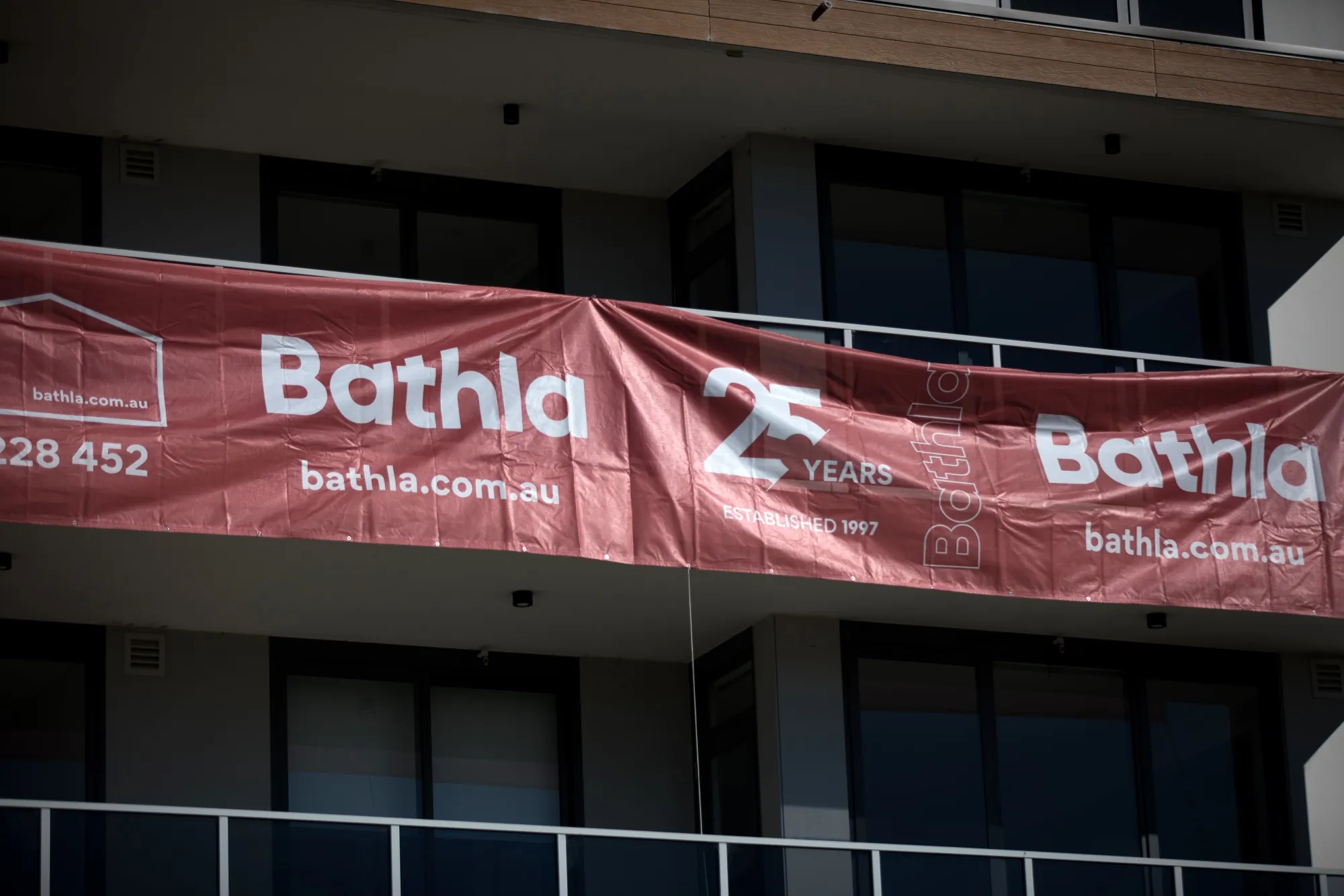
The treatment of an unfinished development depends on its lender, contracts, construction status and any subsequent administration or receivership arrangements. The photograph alone does not establish its current legal status.
The records problem
One of the most consequential reports emerged in September, when ABC News said administrators were attempting to reconcile a sprawling set of accounts and had identified possible overstatements of about A$736 million in inter-company receivables and payables.
The finding was reported as preliminary and subject to reconciliation. It is not a finding that A$736 million was stolen or that the amount represents a realised financial loss. In a group with hundreds of companies, internal balances can be large and complicated; the question is whether records correctly reflect what one company owes another and how those balances should be treated.
Administrators were also reported to be reviewing documents held across staff email accounts, network drives and hard-copy records. Reconstructing the financial picture could take many months. ABC News, 19 September.
That uncertainty makes simplistic claims about the group's assets, solvency and final recoveries particularly unreliable.
A year to investigate does not mean a year of funded construction
On 18 September, the NSW Supreme Court extended the period before administrators must convene a second meeting of creditors to 13 September 2027.
It was a significant procedural decision. It gave Teneo more time to investigate, deal with lenders and work out what options to put before creditors. But the court order did not provide a year's construction funding or guarantee that homes would be completed.
As Reuters reported, the extended process left open different possibilities, including restructuring or eventual liquidation. The path for individual projects would depend on the funding and security arrangements attached to them.
What the collapse reveals
Bathla's size made it significant. Its financing structure made it difficult to untangle. And the consequences have spread beyond financiers to homebuyers, employees and contractors.
The company did not enter administration because it had no land or developments. It entered administration when its cash position and financing arrangements could no longer support the obligations of running the group.
Whether its assets ultimately cover particular claims will depend on sales, outstanding costs, contractual rights and the quality of the financial records. Those outcomes are still being worked through.
The next part of the investigation follows the money behind that structure: the lenders who financed Bathla, the difference between secured and unsecured claims, and the risks faced by investors whose money may have reached the developer through private credit funds.
Continue reading: Who Lent Bathla Billions — and Who Could Lose Money?.
Sources and further reading
- Bathla Group statement on entering voluntary administration, August 2026
- ABC News: Bathla enters administration, 25 August 2026
- ABC News: Bathla's first creditors' meeting, 4 September 2026
- ABC News: Financial records and creditor claims, 19 September 2026
- Reuters: Supreme Court extension, 18 September 2026
- ABC News: Construction stops and staff cuts, 24 September 2026
About this article
This article provides analysis and interpretation of available information. Sources and supporting material, where applicable, are linked within the article.
Found an error? Contact the editorial desk. See our editorial standards and corrections policy.
From the Harbour Creative Blogs archive
Keep exploring this story
Related reporting, people and places from our published coverage. These are editorial connections, not a popularity ranking.
Local coverage
Western Sydney
Coverage of Western Sydney's suburbs, infrastructure, property, workplaces and communities.
Company
Bathla Group
The Sydney property developer at the centre of questions about financing, creditors and unfinished projects.
Organisation
Australian Securities and Investments Commission
Australia's corporate and financial services regulator, covering enforcement, consumers and investor protection.