Australia's New Online Safety Bill Puts Social Media Feeds and AI Chatbots Under Scrutiny
A proposed digital duty of care would impose safety obligations on social platforms, games and AI chatbots, while giving Australians more choice over algorithmic feeds.
 Harbour Creative Team
4 min read
Harbour Creative Team4 min read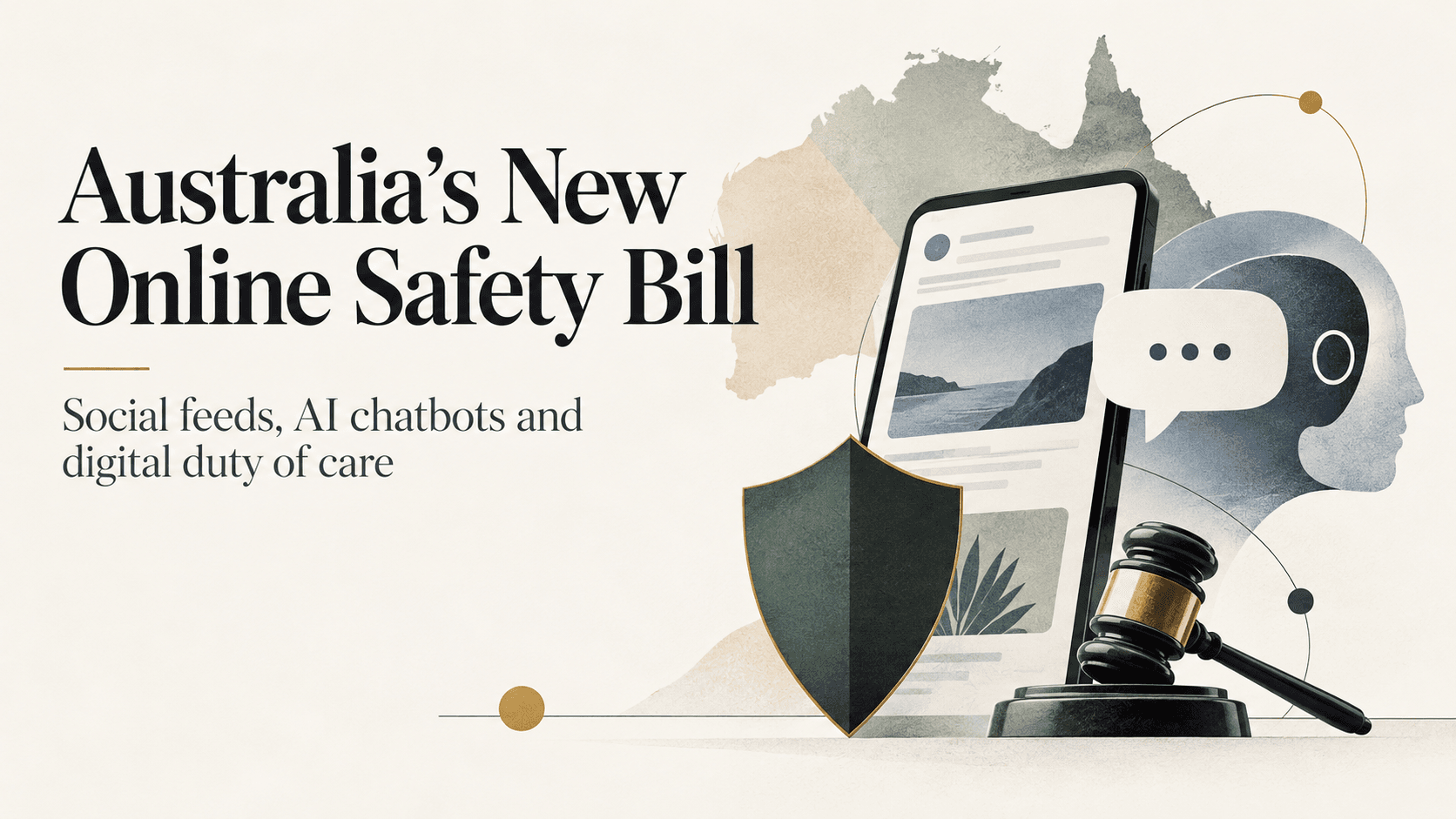
Australia is moving towards a wider set of online safety obligations that would reach beyond traditional social media platforms. The latest proposal includes artificial intelligence chatbots and online games, and raises a question for digital businesses: how much responsibility should a service carry for harms that emerge through its design and operation?
On 20 October 2026, the Australian Government announced that it had introduced legislation proposing a digital duty of care. The announcement also set out proposed changes to how social media feeds work and to the powers available to the eSafety Commissioner.
These measures are proposals, not enacted requirements. Their eventual effect will depend on the legislation's passage and final form.
What the proposed duty of care would cover
According to the government's announcement, online services including social media platforms, online games and AI chatbots would have to meet minimum safety standards. The proposed framework is intended to require providers to take action against specified serious harms, including child sexual abuse material, violent extremist material and non-consensual intimate imagery generated using AI.
The proposals also address harmful experiences for children, including certain categories of dangerous or exploitative material and features.
The breadth of the proposal matters. A platform's responsibilities would not necessarily end with removing content after a complaint. Depending on the final legislation and standards, questions about product design, how features are deployed and how foreseeable risks are managed could become more important.
That direction is consistent with earlier Australian policy discussions about risk assessment, mitigation and safety by design. The detailed duties for particular services still need to be assessed against the final legal text.
A choice between recommendations and following
One of the most direct consumer-facing elements is a proposed choice over social media feeds.
The government says social platforms would have to allow people to decide whether their feeds contain algorithmically recommended posts or content from the people and pages they follow. Consultation on the measure, described as My Feed, My Way, is open.
It does not follow that recommendation systems would disappear. The proposal is about giving users a choice, rather than automatically banning algorithmic recommendations.
For creators, publishers and small businesses, that distinction is significant. Organic visibility today often depends on platform systems recommending content to people who have never followed an account. A more prominent following-only option could make an existing audience relationship more consequential—but its actual impact would depend on user behaviour and the final rules.
It would be premature to forecast reach, advertising revenue or engagement changes from the announcement alone.
Stronger enforcement powers are proposed
The government's announcement also outlines proposed enforcement changes. It says the eSafety Commissioner would be able to issue removal notices targeting services designed or predominantly used to generate fake nude images, and would have a shorter response window for certain cyberbullying and abuse complaints: 24 hours rather than 48.
Non-compliance with the proposed digital duty of care could attract penalties of up to A$109.2 million, according to the government. That is a proposed maximum penalty, not an amount already being imposed under the new framework.
The announcement also points towards minimum standards for complaints and dispute processes. For operators of user-facing products, meaningful complaint handling may become an increasingly prominent aspect of online safety compliance.
What should Australian digital businesses do now?
Businesses should not treat an introduced bill as if it has already changed their legal obligations. Still, the proposal provides a useful signal about the direction of policy.
Operators of communities, marketplaces, social products or AI services can review how users report abuse, who investigates complaints, how long harmful material stays accessible and whether product features create avoidable risks. These are sensible questions even before any new rules take effect.
Small businesses that only advertise on or use larger platforms face a different situation. The important issues are likely to be how platform interfaces, audience reach and user controls change if the proposals pass—not whether every business with a social account suddenly becomes subject to the same duties as a platform.
What happens next
The bill will need to move through the parliamentary process, and the precise scope of its requirements may change. The government's announced consultation on algorithmic-feed choice also leaves practical implementation questions open.
For now, the confirmed development is the introduction of the proposal on 20 October 2026. The broader story is Australia's attempt to move online safety towards prevention, design accountability and greater user control.
That debate reaches much further than social networks. It now explicitly includes the growing market for AI-powered services.
Reported by the Harbour Creative editorial desk on 26 October 2026. This report is based on the Australian Government's 20 October announcement and Parliamentary Library background material. It distinguishes proposed reforms from laws in force.
About this article
This article is published by Harbour Creative Blogs. Sources and supporting material, where applicable, are linked within the article.
Found an error? Contact the editorial desk. See our editorial standards and corrections policy.
From the Harbour Creative Blogs archive
Keep exploring this story
Related reporting, people and places from our published coverage. These are editorial connections, not a popularity ranking.