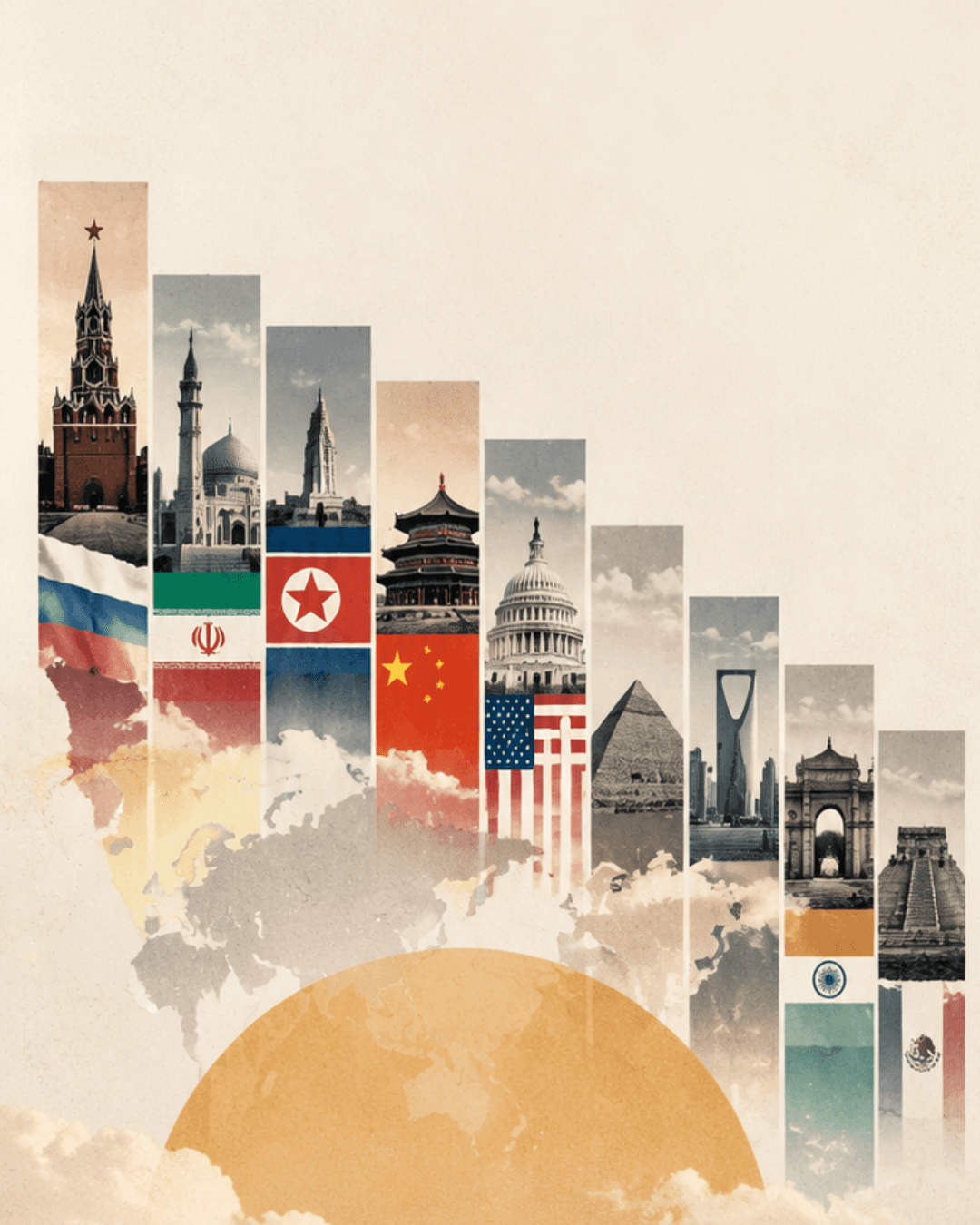
Australians can turn almost anything into a friendly rivalry. Coffee, footy, the weather, whose turn it is to claim pavlova. But ask how we feel about other countries and the answers get a bit more complicated.
In 2026, North Korea received Australia's coldest score in the Lowy Institute's annual feelings thermometer. No great surprise there. Further up the ranking, though, sits the United States, Australia's longstanding security ally. And it is only five points warmer than China.
We examined the 2026 figures, compared them with earlier results and checked what other questions in the poll reveal. Here's what the numbers say, and just as importantly, what they don't.
The bottom ten
Average warmth on a 0–100 scale. Fifty means neither warm nor cold. These are the ten lowest-scoring among the 21 countries and territories measured, not every country in the world.
Source: Lowy Institute Poll 2026, feelings thermometer. Scores are averages, not percentages of Australians who dislike a country.
Start with the number everyone expects. Then look closer.
The three lowest scores went to North Korea (16°), Iran (22°) and Russia (23°). Their positions are unmistakably cold. But the poll asks respondents for an impression, not a written explanation, so we cannot claim to know the precise reason behind each rating.
At the other end of our bottom ten, Mexico (51°) is slightly above neutral; India (49°) is just below it. Treating those numbers as evidence of hostility towards Mexican or Indian people would be both inaccurate and unfair.
The big surprise isn't who's last. It's how close America and China have become on Australia's feelings thermometer.
America is cooling. China is warming.
Australia's average warmth scores in 2024, 2025 and 2026.
Source: Lowy Institute historical thermometer. Point changes calculated from published averages; they do not establish causes.
Australia still wants the alliance. It just feels differently about the ally.
Only 31% of surveyed adults trusted the United States to act responsibly internationally in 2026. Yet 73% still said the US alliance was important to Australia's security. Those are different questions, and that's precisely why they're interesting.
The first asks about international conduct. The second asks what Australia needs for its own security. A respondent can be sceptical about American leadership and still see practical value in the relationship. Importantly, the published totals alone cannot tell us exactly how many individuals held both opinions.
China offers a similarly layered picture. Just 28% trusted it to act responsibly in the world, even as 61% considered it more an economic partner than a security threat in a separate question. Another 62% thought China could become a military threat within 20 years. Those responses measure different things, at different time horizons.
Pick a country
Explore the actual 2026 warmth scores. The bar shows an average, not the percentage of people who approve.
United States — 46°
Below the neutral midpoint by 4 points. This is not the percentage of Australians who dislike United States.
Source: Lowy Institute Poll 2026. All 21 scores reproduced here.
Ten countries, ten very different stories
The ranking is one measurement. The contexts are not interchangeable. These short profiles identify what is known without pretending the poll directly measured people's reasons.
10. Mexico · 51°
Mexico appears in the bottom ten despite scoring just above neutral. A handy reminder that being among the lowest on a particular list does not mean receiving a negative score.
9. India · 49°
India fell two points from 2025, leaving it just below neutral. Its extensive educational, economic and diplomatic connections with Australia make the reading noteworthy, but the survey cannot isolate which aspects respondents were judging.
Equal 7. Egypt · 46°
Egypt finished level with the United States. Identical averages need not reflect identical motivations, and the thermometer cannot identify them.
Equal 7. United States · 46°
America's score dropped 13 points in two years. Separate polling on trust in Washington and the importance of ANZUS helps show why this result is more complicated than a simple popularity contest.
6. China · 41°
Still below neutral, but seven points warmer than in 2024. The same respondents' broader national survey also shows continued concerns about Chinese international conduct and future military risk.
5. Myanmar · 39°
Myanmar was Southeast Asia's coldest-scoring country in this set. Its ongoing political and humanitarian crisis forms part of the international backdrop, but the poll doesn't ask if that drove respondents' answers.
4. Saudi Arabia · 37°
Its score is five points above its previous measurement in 2020. With a six-year gap between those readings, there is no basis for claiming a recent sudden change in Australian sentiment.
3. Russia · 23°
Russia ranks among the three coldest. Its war against Ukraine is essential geopolitical context, but it would be inaccurate to attribute every score to one event without asking respondents directly.
2. Iran · 22°
Survey fieldwork began just after US–Israeli strikes on Iran on 28 February 2026. This timing matters enormously; any interpretation must distinguish the March thermometer from separate later questions fielded in May and June.
1. North Korea · 16°
The lowest score among surveyed places. A separate 2026 question found very little Australian confidence in North Korean leader Kim Jong-un, but a leader-confidence measure isn't the same as a country warmth measure.
And who's getting the warm welcome?
New Zealand registered 86°, the warmest result for the 16th time it has been included. Canada followed at 79°, then Japan at 77°. Apparently the old trans-Tasman jokes haven't dented Australians' overall warmth towards the neighbours.
A change at home, too
The share of Australians saying cultural diversity was positive for the country fell from 90% in 2024 to 73% in 2026.
Source: Lowy Institute Poll, cultural diversity 2024 and 2026.
What can the rankings really tell us?
Public opinion is rarely as tidy as a top-ten list. An ally can score poorly on warmth while remaining important to national security. A major trading partner can inspire both economic interest and strategic anxiety. A country can land in the bottom ten without scoring below neutral.
And none of this measures the personal worth, behaviour or welcome deserved by people from those countries who live in Australia.
So the next time someone tells you confidently which country Australians can't stand, it's worth asking a few more questions. Which Australians? Which countries were included? What was the actual question? And when did they answer?
Turns out a good stickybeak needs a little more than a headline.
How we checked the numbers
Harbour Creative independently analysed publicly available findings from the Lowy Institute Poll 2026; we did not conduct this survey. The Social Research Centre surveyed 2,013 Australian residents aged 18 and over between 2 and 15 March 2026 using its probability-based Life in Australia panel. The simple-random-sample margin of error was approximately ±2.2 percentage points, with a survey design effect of 1.13. Different measures, particularly average warmth scores, require their own uncertainty treatment.
Country scores are mean 0–100 ratings among eligible responses, not percentages expressing dislike. Respondents could indicate no opinion or unfamiliarity. Close country scores should not be presented as statistically distinct without confidence intervals. Historical data may be affected by changes in survey mode. A separate May–June 2026 mini-poll covered specific questions on the Iran conflict and fuel reserves; it must not be conflated with the March thermometer.
Primary references: Full 2026 Poll and methodology, pp. 8–9, 30–31 · Feelings thermometer · Trust in global powers · US alliance · Cultural diversity.