Australia's International Student Decline Is Becoming a Problem Beyond Universities
International student numbers are falling across Australia. We examine what the contraction means for local businesses, casual employment, rental markets, and regional economies.
 Harbour Creative Team
6 min read
Harbour Creative Team6 min read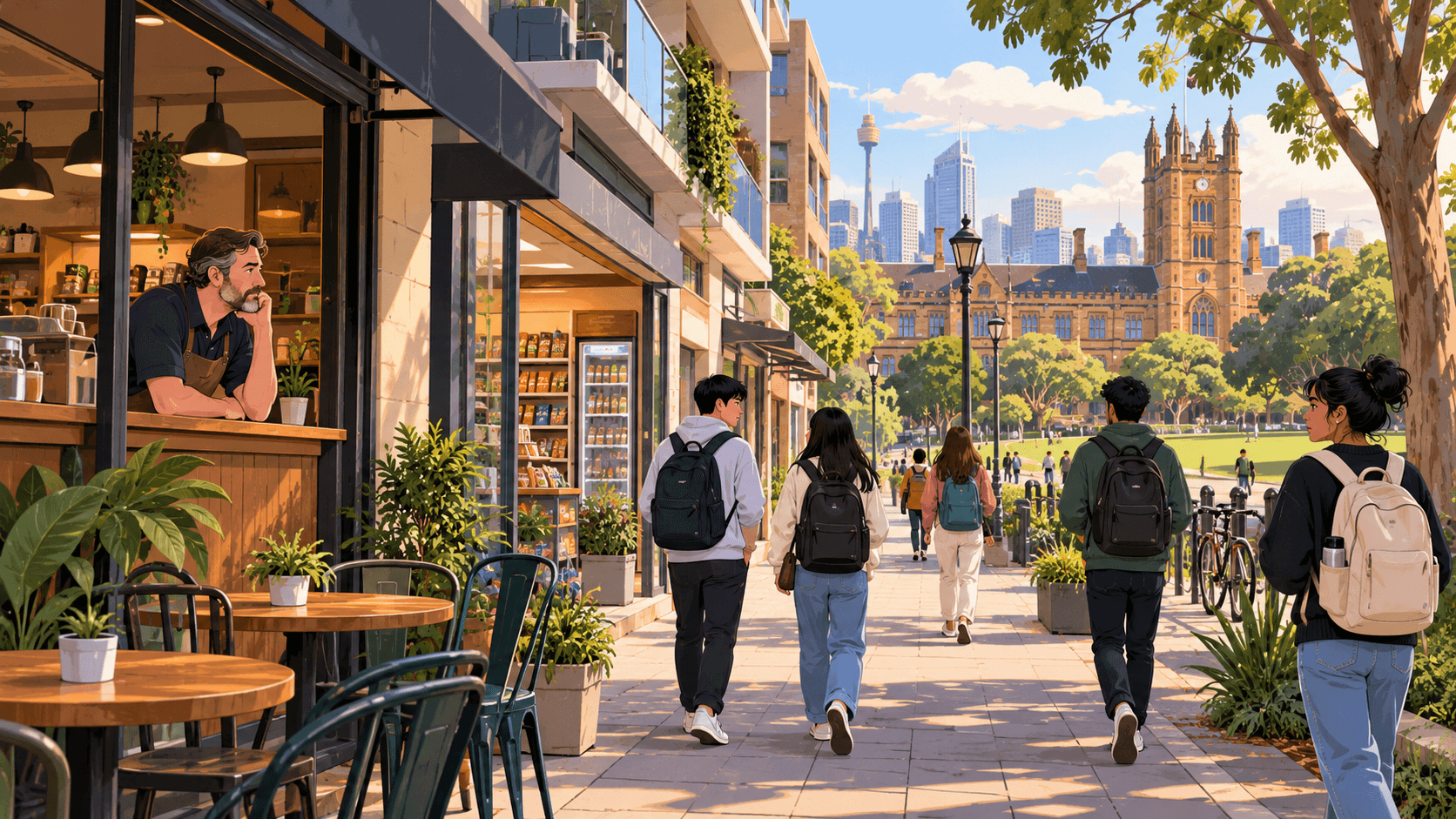
The debate over Australia's international student numbers has been treated largely as a dispute between Canberra and university vice-chancellors. But on high streets, suburban retail strips, and regional service hubs, the financial consequences of a shrinking student cohort are already unfolding.
When the federal government proposed capping new international student commencements at 270,000 under the Education Services for Overseas Students (ESOS) Amendment Bill, public attention fixed on tertiary balance sheets. University leaders warned of hiring freezes, postponed research infrastructure, and cancelled courses.
Yet universities represent only the front door of Australia's fourth-largest export industry.
Official data released by the Department of Education for year-to-date June 2026 confirms the sharpest policy-driven contraction since the 2020 border closures. Across Australia, active international student numbers fell 7.0 per cent year-on-year to 687,810—a net reduction of 51,710 individuals. Total course enrolments declined 8.0 per cent to 771,270, while new commencements fell 9.0 per cent to 234,038.
Crucially, more than half of every dollar generated by international education is spent outside university gates. As enrolments contract, the fallout is cascading into local retail, casual labour, housing, and regional business districts.
Tracking the Contraction: From Campus Gates to High Streets
Comparing official education statistics with off-campus economic exposure in local hospitality, retail, and accommodation.
The Official Contraction: Department of Education Figures
Year-to-date figures to June 2026 show systemic declines across enrolments, commencements, and pathway programmes following federal visa tightening.
Down 51,710 individuals compared to June 2025
Decline across higher ed, VET, and pathways
New starts across all tertiary sectors
Leading pipeline indicator for 2027 degree starts
The Anatomy of an Export: The $28 Billion Off-Campus Economy
Public discussions typically cite the headline export valuation: $50.5 billion in 2024–25, according to the Australian Bureau of Statistics (ABS).
Unlike iron ore or agricultural commodities, however, education exports are consumed entirely within Australia.
In a landmark study in the RBA Bulletin (July 2025), central bank researchers revealed that approximately 55 per cent of all international student spending—roughly $27.8 billion annually—consists of non-tuition goods and services in the broader domestic economy. Rents, groceries, utilities, public transport, dining, and telecommunications make up this off-campus total; tuition accounts for the remaining 45 per cent.
The Independent Spending Contraction
To measure the impact on domestic commerce, Harbour Creative cross-referenced Department of Education headcount reductions with federal financial thresholds.
In May 2024, the Department of Home Affairs raised the minimum financial capacity requirement for student visas to $29,710 per year, reflecting baseline capital-city living costs.
Applying this baseline to the 51,710-student reduction documented in the June 2026 figures reveals an immediate spending hole:
- 51,710 fewer students × $29,710 annual living baseline = $1.536 billion removed directly from off-campus Australian retail, services, and accommodation over twelve months.
This $1.536 billion contraction excludes lost tuition fees, flights, or visa fees. It represents money previously circulating through supermarket tills, suburban pharmacies, transit networks, and neighbourhood hospitality.
Dual Shocks to Hospitality and Casual Labour
In precincts bordering major campuses—such as Carlton and Clayton in Melbourne, Ultimo and Kensington in Sydney, and St Lucia in Brisbane—international students serve as both critical patrons and vital staff.
The RBA found that international students fund between 25 per cent and 33 per cent of their living expenses through domestic jobs, working under the 48-hour fortnightly cap in hospitality, retail, and aged care.
Their departure creates a dual shock:
- Demand Contraction: Foot-traffic has slumped during weekday trade and semester breaks, hitting cafés, Asian grocers, and convenience retail built around dense student flows.
- Roster Shortages: International students routinely fill unsociable shifts and weekend roles. Operators in university corridors report persistent difficulty filling kitchen and floor rosters, despite steady award wage growth.
Operating on slim margins of 3 to 6 per cent, independent businesses cannot easily absorb this double hit.
The English Pathway: The Leading Pipeline Canary
While university degree commencements fell by single digits, the steepest decline hit entry-level language pathways.
Department of Education figures show commencements in English Language Intensive Courses for Overseas Students (ELICOS) collapsed by 27.0 per cent year-on-year.
ELICOS is the tertiary sector's primary leading indicator. Most language students do not leave after finishing English studies; they articulate into vocational diplomas or bachelor degrees. A 27 per cent collapse in 2026 locks in an automatic pipeline deficit for undergraduate enrolments throughout 2027 and 2028, ensuring that current business downturns are the beginning of a prolonged slump.
Geographic Asymmetry: Regional Providers Left Stranded
The contraction has struck unevenly. While elite Group of Eight metropolitan institutions retain global prestige, regional universities face severe disruption.
Under Ministerial Direction 107—which prioritized visa processing for low-risk, well-resourced institutions—visa processing for regional and vocational providers slowed drastically.
Reporting by The Guardian on 11 October 2026 revealed that while major public metropolitan universities operated at roughly 66 per cent of indicative government caps, several regional universities hovered near 40 per cent.
| Metric | Metropolitan Tertiary Precincts | Regional University Hubs |
|---|---|---|
| Cap Utilisation Rate | ~66% of indicative limits | ~40% of allocated capacity |
| Visa Grant Processing | Prioritised under Tier 1 | Protracted delays under risk tiers |
| Local Economy Exposure | Buffered by diverse city commerce | Heavily reliant on student spending |
| Housing Market Impact | Modest easing in inner-city apartments | High vacancy risk in dedicated housing |
| Casual Labour Pool | Buffered by local domestic students | Acute shortages in aged care & services |
In regional centres like Armidale, Lismore, Rockhampton, and Townsville, universities are cornerstone economic engines. Lacking deep corporate ecosystems, regional towns feel student losses immediately across housing rentals, taxi networks, and healthcare rosters.
Documented Evidence Versus Plausible Risks
Assessing this structural shift requires separating documented facts from plausible projections:
Documented Empirical Evidence (Current Data)
- Contraction in Enrolment: Active students down 7.0 per cent (to 687,810) and commencements down 9.0 per cent (Department of Education, June 2026).
- Pipeline Collapse: ELICOS commencements down 27.0 per cent, locking in lower subsequent intakes.
- Off-Campus Share: Official RBA modeling confirming 55 per cent ($27.8B) of education export credits goes directly to domestic living expenses.
- Direct Local Loss: Harbour Creative's calculated $1.536 billion annual baseline reduction in off-campus consumer spending.
Plausible Economic Risks (Near-Term Projections)
- Rental Market Nuance: While inner-city apartment rents have eased slightly in Sydney and Melbourne, outer-suburban housing relief remains negligible, as students rarely lease detached family homes.
- Student Accommodation Investment: Purpose-built student accommodation (PBSA) funds face delayed occupancy benchmarks, potentially cooling private investment in student housing.
- Skilled Labour Pipelines: Lower student intakes risk starving critical regional sectors of graduate nurses, engineers, and educators over the medium term.
Policy Crosscurrents and Business Outlook
These economic headwinds unfold against prolonged political contention. Minister Jason Clare's 270,000 national cap under the ESOS Amendment Bill encountered rigorous Senate committee scrutiny. Submissions from the Business Council of Australia, the Australian Chamber of Commerce and Industry, and the Student Accommodation Council warned that blunt caps risk widespread economic collateral damage. With the Federal Coalition proposing a deeper reduction to 150,000, policy volatility remains high.
For Australian business operators, international education cannot be viewed as an isolated university export. It is an intricate domestic demand engine. With student numbers resetting at lower baselines, businesses across retail, hospitality, and housing must navigate a sustained $1.5 billion reduction in annual consumer spending.
Methodology and Research Notes
Data sources current as of 11 October 2026:
- Australian Department of Education: International Student Data, Year-to-Date June 2026, recording 687,810 active students (-7%), 771,270 enrolments (-8%), 234,038 commencements (-9%), and ELICOS commencements (-27%).
- Reserve Bank of Australia: RBA Bulletin, July 2025, establishing that 55% of education export revenue is non-tuition living spending and 25%–33% is self-funded via domestic work.
- Australian Bureau of Statistics: Balance of Payments (Cat. 5368.0), confirming 2024–25 education exports of $50.5 billion.
- Department of Home Affairs: Student visa living capacity threshold ($29,710/year).
- The Guardian Australia: Sector reporting (11 October 2026) on cap utilisation rates.
About this article
This article provides analysis and interpretation of available information. Sources and supporting material, where applicable, are linked within the article.
Found an error? Contact the editorial desk. See our editorial standards and corrections policy.
From the Harbour Creative Blogs archive
Keep exploring this story
Related reporting, people and places from our published coverage. These are editorial connections, not a popularity ranking.
Organisation
Reserve Bank of Australia
Australia's central bank, including inflation, interest rates and the effects on households.